Friday, December 01, 2023

My Only Hope

With Len (far right) and others at Irv's Burgers

One year ago today, I had just landed at LAX and turned on my phone to find a text telling me that my good friend Len Davies was gone. I had visited Len in the hospital before leaving town and hoped to get back to LA in time to see him again. I knew he'd taken a turn for the worse but thought there would be more time. But I was too late.

I was stunned by the news, Len was the epitome of optimism, positivity, and the power of hope, and now all of that seemed to disappear with two simple words: "He passed." How is that possible, that someone so filled with life and spirit and energy can just be taken away from us so utterly and cruelly? That's what I've been wondering this past year. I've often thought of Len as my Obi-Wan, my "only hope" in the struggle against the dark side -- though I think Len would prefer to be thought of as Yoda. But he represented a beacon of possibility in a world of disappointment and frustration and discouragement. He was always there with a happy thought, a bit of hopeful news, a cheerful "dear boy" to brighten my day and lift me from the doldrums into his world of limitless potential. 

And then he wasn't. 

I first met Len at Irv's Burgers in West Hollywood following a referral from my friend Richard Hench, who knew Len from their having worked on a movie together. Len had an idea for a TV show called Emergency LA that would follow paramedics, cops, and ER staff through a series of interconnected storylines. I liked the idea right from the start and I liked Len, too. I agreed to write the pilot episode based on Len's outline, thus beginning a partnership, friendship and collaboration that continued for nearly ten years, and in some ways continues to this day. 

Working with Len was one of the most enjoyable creative endeavors I have known. I'd write a scene, based on his outline and send it to him for review and he would lavish me with praise for 'realizing his vision' but also come up with suggestions and ideas to solve plot issues and improve the story. He never balked at my suggestions but took them in and ran with them like a true master of improv, employing the principle of 'yes, and...' to build upon what I'd written and take it to the next level. Our phone calls could go on for hours and I'd end up with a notepad full of new ideas and a head full of new scenarios. I've never met anyone who could 'break' a story like he could. There were no dead ends, just more pathways to explore and more treasures to discover. 

As is often the case, our journey with Emergency LA had its ups and downs, a few more downs than ups, actually. Now and then we'd get some news that this or that production company/network/distributor/financer was interested, only to have things fall apart or go up in smoke -- such is show biz. But through it all, Len kept the energy going. We continued to work on scripts, visit locations, check out office/studio space. At one point Len got involved in a plan to buy an old studio, refurbish it and use it to shoot the show ourselves. It was an ambitious plan and very exciting to think about -- and it may have worked if we'd had more time. But time was not on our side. 

Meanwhile, I was going through some personal upheaval that required me to fly back and forth to the east coast several times a year, and true to form, Len was there for me. He let me keep my car in his garage for weeks at a time when I was away and came to pick me up at the airport when I came home. I was unemployed and had no way to repay him, but he brushed that aside saying, "You're family." And that was how it felt with Len, like family. We were in this thing together and win or lose, we had each other. 

Now it's been a year since he's been gone and the silence has been almost unbearable. No more lengthy phone calls discussing everything from casting choices to space exploration to Beatles trivia. No more making plans for the new studio or renting the Batmobile or playing music together. No more boundless enthusiasm to buck me up when everything seemed a lot less than hopeful. He left a big hole in the world that isn't easy to fill. 

But he left something else, too: his family. As part of Len's extended family I've had the great pleasure to get to know his son Toms, who despite dealing with a staggering series of ordeals on top of the loss of his dad, has shown an astounding capacity for resilience and perseverance that inspires me over and over again. I've also met other extended family members who cared about Len as much as I did and our connection to Len has formed a bond that continues in his absence. Len's generosity and love touched so many people and those of us who were lucky enough to know him feel like we were part of something that transcended simple friendship. He may not be with us anymore but as his final gift, he brought us together. 

And that's a pretty nice gift.

I guess Len wasn't my only hope after all, because, having come to know Toms and the other members of our extended family, I now know that there is always hope and there is always plenty of love to go around and that like Obi-Wan, Len is out there somewhere watching over me. 

And sometimes, I can still hear him saying, "Cheers, dear boy."

Sunday, July 03, 2022

The Last Time I Saw Richard


Richard Hench 1955-2022

I first met Richard at a screenwriter’s group called Deadline Junkies. Richard was one of several talented and generous actors who showed up every week to do cold readings of screenplays submitted by the writers. I cast Richard as the patriarch of a wealthy Connecticut family, who owns a rare bird that my main character accidentally lets out of its cage and then very nearly crushes with a squash racquet while trying to shoo it back inside. Richard was excellent in the part, providing the needed arrogant gravitas as well as the requisite white-male-privilege-y overtones. But in real life, he was nothing like that character. He was a keenly sensitive artist with a deep inner life of his own, which he was able to draw upon to breathe life into a bunch of silly words on a page.

I didn't really get to know Richard well in the Deadline Junkies because I ended up leaving soon after he joined. But a little while later, when a friend of his named Len was looking for a writer for a new television project he was working on, Richard set up a meeting. Len had envisioned Richard as one of the main characters in his one-hour TV drama, a motorcycle-riding, combat-veteran-turned-chief-surgeon in a busy downtown Los Angeles hospital. I did my best to do justice to Dr. Pierce Thatcher while writing the two-hour pilot script.


About a year later, I ran into Richard at a Fourth of July cookout at Len’s place. Richard told me he had read the pilot script I’d written and was very impressed with the results. His approval meant the world to me. I began consulting Richard from time to time for insights into his character and motorcycles, and life in general. Richard had a lot of insights.


A few years later, when I was down on my luck and living on credit cards, Richard came up with a project for the two of us to work on. It was a script about the many years he had spent in the movie business – and the best part was, he wanted to pay me to write it. Richard had a history of supporting fellow artists, not just financially but with his time, his talent, his vast knowledge of movie-making, and on more than one occasion, his own home. By giving me the gift of hiring me to write a screenplay for him, Richard made my longtime dream of becoming a professional screenwriter a reality.


Our idea was to tell the story of his life through a series of films-within-the-film, depicting the various stages of his career via some of the dozens of movies and TV shows he’d worked on. Over the course of many phone calls, lunch meetings and in-depth story sessions, we came up with a number of sequences highlighting the major turning points in his life in and out of the movies – each one to be filmed in the style of the particular film-within the film representing that era. The different sequences would be stitched together with a present-day story about Richard desperately trying to get to a friend's house in the middle of the night, for an emergency cash loan, but his Harley suffers a blowout on the 405 and he nearly careens into a Peterbilt truck, just like the one in the movie Duel. He coasts to an all-night gas station off the freeway where, in the wake of his near-death experience, he looks back on his years in Hollywood, while waiting for a flatbed tow truck to rescue his Harley.


While most of our brainstorming sessions were fun and creative, there were also a few times we butted heads. There was one scene in particular that Richard wanted me to change. It was based on an experience he’d had with another actor on one of his many location shoots. In the scene, a famous TV actress, who is playing one of the leads in the film-within-the film, swallows a bunch of sleeping pills and Richard is called upon to revive her. He manages to do so using his boundless ingenuity coupled with his natural empathy, and afterwards the TV actress tries to seduce him. I had written it with a fairly comic tone, similar to the rest of the script, but Richard felt that my take was too broad and not appropriate for the subject. We went around and around as I tried to understand where he wanted to take the scene. At one point he referred to my ‘frat-boy’ style of humor and that felt like a slap in the face.

We continued our discussion from the restaurant out into the street, and eventually to my apartment, where Richard got down on the floor and started acting out the scene. He was curled up in the fetal position, like the actress had been, kind of whimpering as he voiced her thoughts. It was pretty intense. I sat on the floor next to him and took notes as he walked me through the scene. I could see that he wasn’t just playing the scene, he was reliving it. He needed me to understand that the place she was in was real and not just a manufactured moment in a script. He needed me to feel what she was feeling. 


“I think I get it now,” I said.


“It’s the heart of the movie,” said Richard, his eyes welling up with tears.


“Yeah,” I nodded. ”It is.”


“The heart of the movie.”

The last time I saw Richard, we had french toast at Joey’s Cafe in West Hollywood. French toast had become kind of a tradition between us during our story meetings. After breakfast, we walked up the hill to DeLongpre Avenue, one of my favorite blocks in the neighborhood, with its wide front lawns and many flowering trees. There was a pretty young woman walking her little doggy in the lush grassy space in front of her building. Naturally, Richard started up a conversation with her. She told us the dog had cancer and she was running out of options. She wanted to keep up the treatments but she knew it wasn’t really going to make any difference. Richard knelt on the grass and played with the dog, showering him with every ounce of his attention and love. The little guy was in heaven. We wished her good luck and walked back to my place.


In the parking lot across from my apartment, Richard got onto the Harley and started it up. He rang the bicycle bell he’d attached to the right handlebar and grinned that devilish movie-star grin. It was a perfect moment: the childlike chime of the bell ringing out above the badass rumble of the Harley captured Richard’s spirit to a T. He popped into gear and rode out of the lot, swinging onto Havenhurst Drive and waving goodbye as he thundered out of sight.


Richard and I had plans to meet my cousin in the Valley for an al fresco French toast brunch date, but we never got the chance. Len called me one afternoon with the mind-numbing news that Richard had taken his own life the night before. We didn’t have any more information than that, but we were, in Len’s words, gutted. 


Since then I’ve met with Richard’s friends, neighbors and his sister and learned a little bit more about what happened, but none of it can explain to me why he is gone. On one hand, it really seemed like Richard was doing well and looking forward to new projects and opportunities. On the other hand, there was always something just below the surface, maybe the same thing that made him such a sensitive and honest actor, but that always seemed to be pulling him in the other direction. Or maybe it just seems that way now. I don’t think I will ever know what really happened, but I do know that I miss him and that French toast will never taste quite the same. 


As Hamlet said, “I shall not look upon his like again.”


Sunday, December 26, 2021

The Christmas Miracle


I didn't want to share this until I knew the ending, and as of today, I do. Three days before I left town for 'Xmas In CT' my car was stolen. Kind of a bummer, even though it was an old car and I never used it much -- in fact, since I started working from home, the only reason I drove it was to keep the battery charged. But it was my getaway car -- I liked knowing that if I needed/wanted to escape the confines of West Hollywood, I could. Run an errand, visit a friend -- it was always there for me. Except, the other day, when I went out for a quick trip to the barber shop...

It. Wasn't.

Weirdly, there was another car approximately the same year and model -- 20 year old Honda CRV -- parked in about the same spot on my street. I even walked up to it thinking it was mine, except it was the wrong color and the window was open and the motor was running. Seemed odd.

I searched up and down the block several times before facing the hard truth: somebody took my car! I called the West Hollywood Sheriff and a young deputy arrived to take my stolen vehicle report. He told me he had circled the block a few times, just to make sure I hadn't merely forgotten where I'd parked. He said that happens a lot. He, too, saw the other CRV and ran the plates. Apparently, it had been stolen the day before, about 20 miles away. 

"Some coincidence, huh?" he said.
I was doubtful. "That ain't no coincidence."

An older deputy arrived and told us that whoever stole the first car probably dumped it before stealing mine. Then, his partner comes along and picks up that one while mine gets driven over to the next 20-year-old CRV -- lather, rinse, repeat. Last year they were doing the same thing with Hyundais, this year CRVs.

Just my luck.

We finished filling out the report and I asked if there was any chance they would find my car. The young deputy shook his head. "Not really."

I flew to Connecticut a few days later and told everyone the story -- by this point I had accepted the situation. I really don't need the car, so no great loss, right? Why let it ruin the holidays?
But then, the next day, I got a call from a deputy at the Compton Sheriff's Station -- he said they'd found my car!

It was a bona fide, according-to-Hoyle Christmas Miracle!

Only...

The car had been towed to an impound lot in Compton and I needed to go claim it. In person. In Compton. And pay the towing fee, plus the storage costs -- forty bucks a day and mounting. By the time I got back to California it would be a hefty sum. Surely there was another way to retrieve my car. But what?

My brilliant nephew, age 10, suggested that I Google it.

Clever lad.

Turns out you can send an authorized 'agent' to pick up your car for you, with an original signed and notarized form. So, after some more Googling, a slew of phone calls, some cutting and pasting, a quick trip to the town library (free notary service!) and a last minute dash to FedEx, the form was on its way to my cousin in the San Fernando Valley -- a mere 40 miles from Compton.

But, this was, as you know, a holiday weekend. And both the Compton Sheriff's Station and the impound lot were operating on holiday hours. My cousin had a less-than-two-hour window this morning to make it all work: Uber to the Sheriff's Station to get the vehicle release form, another Uber to the impound lot to pick up the car then drive it back to his house. Everything started off well, and my cousin was doing me the biggest solid of all time. He got the release form with minimum hassle, then a short trip over to the impound lot -- he got there early, so he had to wait outside the gate for an hour. Alone. On a back alley in Compton. Finally, he got inside with all the proper paperwork, paid the fees and charges, and they released the car to him, no problemo.

But...

It wouldn't start.

I was crushed. Now what? Tow the car all the way out to the west valley? Seriously? I called the guy in the main office and he said they could try giving it a jump start. I said I thought that might be a good idea.

Fortunately, that solved the problem and within minutes my cousin was in my car on the freeway, heading for home.

Victory!

So, now my CRV is sitting safely in my cousin's driveway in the west valley, with no more storage charges. A triple Christmas miracle, at least. And I have my getaway car again!
Such a major relief.

I think I might just sell it.


Wednesday, April 22, 2020

Close to Home

I've been hearing a lot of sirens lately. Or at least it seems that way. Whenever I hear a siren, I think, just don't be coming this way. I'm always relieved when I hear them pass by. Someone else's bad luck. But the other day I heard a siren that kept getting closer, and closer, and closer. It sounded like it stopped right outside my apartment building. I put on my mask and went outside to investigate.


There were two cop cars and a paramedic truck parked in front of the building next door. Someone was lying on the patch of ground between the sidewalk and the curb. Two paramedics were administering CPR. An ambulance arrived and two more paramedics wheeled a gurney over to the sidewalk.

Several people were gathered in front of my building. Everyone had a mask, but some had them pulled down below their chins. Nobody was observing the six-foot rule. Especially not the cops. I overheard a young woman say she'd found a man slumped over in his car and called 911. She was instructed to pull him out of the car and perform CPR until the paramedics arrived. I looked back toward the man on the ground. Then at the car parked beside him.

I turned back to the young woman, "Was it the blue car?"
She nodded. "Oh shit," I said. "I know him."

The blue car belonged to our building manager, Gordon, a man I've known since the day I moved in, nearly two decades ago. I knew him about as well as you know anyone else who lives in your building -- we'd stop to chat occasionally as we passed each other on the way in or out. I remember when he got the new car, the blue one. He'd had his old one about as long as I've had mine, which is way too long, and was pretty happy with the upgrade. Gordon lived alone and I never saw him with family or friends. I knew he had a cat because he'd built a wire-enclosed walkway on the outside of his third floor windows so the cat could walk outside from one window to another. I thought that was pretty cool.

I saw the paramedics preparing to inject Gordon with epinephrine in hopes of stimulating his heart. I knew this because of my research for a TV script I'd written. I'd never actually seen it done before. They gave him the injection, but it didn't seem to help. By now they had rigged up an automatic compression machine that was pumping his heart for him and causing his body to spasm with each compression. His skin was pale and his entire body was limp. I couldn't see his face.

The police asked me to identify him so I moved closer, but they made me stop. I told them who the blue car belonged to and that he was the manager of my building. They asked me how old he was but I had no idea. I guessed mid-fifties.

The paramedics were clearing the immediate area and attaching electrodes to Gordon for defibrillation. Everyone stood back. I could see his face now. It was him, but ashen and lifeless. One of the paramedics said, "Clear." Gordon's body jolted from the shock of the defibrillator. The paramedics waited for a moment, checking his vitals, then tried again. "Clear." Another jolt. More waiting. More checking. Nothing.

The people on the sidewalk shared random thoughts, "I just saw him the other day." "I didn't know he was sick."

The four paramedics transferred Gordon onto the gurney. The CPR machine was back in place. They wheeled him over to the ambulance and loaded him inside. I saw his face again as they went past. I knew it was probably the last time I would see him.

I spoke to the young woman who had tried to revive Gordon. We traded numbers so I could keep her apprised of his condition. Her name was Brianna. She said she felt invested.

The police gave me Gordon's keys to hold onto. My hallmate volunteered to go up and look in on the cat. Those of us remaining on the sidewalk said awkward goodbyes. Eventually the police cars drove away and we all went inside.

I called the Sheriff's station and got the name of the hospital. When I called the hospital, I was told Gordon was 'under evaluation.' I didn't know what that meant, but I wanted it to mean there was still hope. I waited an hour and called again. This time I was told he'd been discharged.
I was confused, "Discharged? You mean they sent him home?"
"Discharged from the ER."
"What does that mean?"
I was transferred to the ER, where I was told that Gordon was no longer a patient.
"So he didn't make it?" I asked.
"We can't give out any information."

Later that night I got a text from my landlord. Gordon had died. I waited until the next morning to pass on the sad news to Brianna. She told me she was devastated. I told her that the fact that she cared enough to do something meant a lot. She seemed comforted by that. I hope so.

I don't know, and will never know, why Gordon died. But I don't think it was a random coincidence. When an otherwise healthy man drops dead in the middle of a pandemic, there has to be a connection. I'm sure he tried to stay safe like we all do, but masks and gloves are not magic talismans. It's one thing to hear politicians talk about 'acceptable percentages' and another thing altogether to watch a friend dying on the sidewalk right in front of you.

Sometimes we don't take things seriously until they hit close to home. There are a lot of people who seem to be in denial of what's happening in the world today. I hope it doesn't take a tragedy for them to wake up to reality. But I'm afraid it probably will.

Monday, February 03, 2020

Hitching to Davidson

Author Dean Rama Christ reads a passage from The Fire and The Rose describing a Kerouac-like hitchhiking odyssey in North Carolina in the late '70s The Fire and The Rose is available on #AmazonBooks click here

Monday, December 09, 2019

Midnight on the D Train

As I board the train, a few minutes after midnight, the subway looks nearly as crowded as if it were midday. Populated with second-shift commuters, dragging their tired asses home to Flatbush, Bay Ridge, Brighton Beach and a dozen other neighborhoods after another long workday’s journey into night. Faces slack with resignation and sleep deprivation, just hoping to get home in time to grab a late dinner and maybe see something good on TV before snatching a few hours’ sleep and starting the whole dreary routine again tomorrow.


I don’t work the second shift. My workday began around 9:30 a.m. as usual, but I had a couple of deadlines hanging over me, so instead of catching my usual rush-hour train home, I find myself amongst the bleary-eyed on the midnight D Train. The warning bell chimes, the doors close, and we roll on toward downtown and Brooklyn.
I snag my favorite seat, back to the wall and directly next to the door. I like having the pole right there for stability, and also because I once read an article about using the pole for leverage in certain defensive moves in case things get sketchy. So far I’ve never needed to deploy any defensive moves on the subway, and I’m not sure if I’ll be able to perform them if I have to, but it’s a comfort to know the pole is available if anything goes down.
A quick survey of my fellow travelers reveals a mostly working-class vibe, some in the uniforms of their trade: food service, custodial, security, delivery, retail etc. Others wear the less formalized but still standard uniform of the middle-level office worker, i.e., comfortable shoes, skirts or slacks (not jeans) and shirts with collars and buttons. A few sport a more professional look, but there are no suits on this train. Anyone who wears a suit and works this late gets a voucher for a town car home. This train don’t carry no vouchers.
One of the more professional-looking passengers sits diagonally across from me, in the seat on the other side of the opposing doorway, next to the pole. Maybe she read the same article about subway self-defense that I did. She’s petite and pretty, but with a decidedly low-key, no-nonsense air about her. She wears a thin gold ankle bracelet that glints in the harsh fluorescent light. It catches my eye. I’m not the only one who notices.
A lanky dude sprawls across from her, wearing jeans and work boots and a canvas jacket with that fake sheepskin lining. He leans forward on the edge of his seat, his forearms on his thighs, and speaks to her in a low, resonant voice. I can’t hear what he’s saying, but I can tell that it’s directed at her. I can also tell that she doesn’t like it.
Her downcast eyes do their best to avoid his intrusive gaze, but her tight jaw and stiff shoulders shriek, “Go away!” He continues his monologue, either unaware of her unease, or perhaps turned on by it. She tries to ignore him, but he is clearly bothering her. At one point she responds, in a voice too soft for me to understand. She might be trying to discourage him in some way. She obviously doesn’t want him to continue. But whatever she's saying, it isn’t working. He leans even further forward into the open space between them and resumes his verbal assault.
I now lean forward on the edge of my seat, one hand on the pole, ready to lunge. I want so badly to do something, to leap to her rescue, to run off this dirtbag who keeps sniffing around where he isn’t wanted. It’s a primal thing, emanating from deep down in my lizard brain: Save the girl! But this is New York and there are unspoken rules about getting involved in other people’s business. There are lines you don’t cross, especially late at night on the subway. Besides, I’ve learned through clumsy experience not to assume that women need or even want my help. She’s an adult who can take care of herself. Better to let her find her own solution.
But it’s getting hard to watch.
The train rumbles up out of the tunnel and onto the lower level of the Manhattan Bridge. Normally this would be the highlight of the ride, where the claustrophobic darkness of the tunnel gives way to the glittering lower Manhattan skyline, framed by the Brooklyn Bridge, as it spans the East River with a kind of formidable grace. An inspiring sight on most evenings, but tonight it seems empty and false. I look around to see if anyone else has noticed the creepy tableau at the front end of the car.
The guy sitting across from me leans forward just like I do, his attention riveted on the unwanted suitor. Same with the guy in the nearby forward-facing seat, and the guy across from him, and the two guys behind them. There must be at least six of us poised for action, muscles tensed, jaws clenched, attention focused on the wolf in the sheepskin jacket. But nobody moves. A couple of them acknowledge my glance, but most keep their eyes fixed on the target. The situation has galvanized our lizard brains. We have formed into a cadre. Or maybe a mob.
The train rattles as we come off the bridge and descend back into the darkness of the tunnel. The next stop is DeKalb Avenue, where you can transfer to the BMT line. Maybe the woman with the ankle bracelet will get off there. But for now, the wolf in fake sheepskin still has her cornered, if only through sheer relentlessness. What does he think will happen? That she eventually succumbs to his advances and invites him back to her apartment for the night? Can he not perceive her revulsion and fear? Or is fear the whole point? I really want to smash his face.
The lights of the DeKalb station flicker past the windows. Brakes squeal and the train rocks slightly as it slows. The platform is nearly empty. We screech to a jerking halt, our car positioned toward the back end of the train. The woman with the ankle bracelet scans the platform. The bells chime and the doors open. She stands and strides out of the car, past her aggressor. He hardly seems to notice.
I watch through the open doors as she walks up the platform. Few things are certain in life, but the fact that you can never find a cop when you need one is all but guaranteed. Especially in Brooklyn after midnight. But I think I spot a transit cop standing in the middle of the platform, about thirty feet away. The woman with the ankle bracelet must see him too, because she’s making a beeline right for him. Fake sheepskin hasn’t moved. I can see the woman talking to the transit cop and then I hear the warning bell. The doors shudder. All I need to do is reach my left hand out about a foot and catch hold of the door to prevent it from closing. The door jolts against my grip, and then automatically slides back open.
The woman and the cop come back to our car and step inside. She points to the man in the fake sheepskin jacket and the transit cop takes him by the arm and stands him up. I can’t make out what he says but it’s a short and one-sided conversation. Fake sheepskin offers no resistance. Possibly not his first encounter with law enforcement. The warning bell chimes again, but I still have a tight hold on the door and I keep it open until the transit cop hustles fake sheepskin out onto the platform.
The woman with the ankle bracelet regains her seat. The bell chimes and the doors now close without hindrance. I look around the car. No one sits forward on the edge of his seat. No more tension, no more aggression. The natural order has been restored. I lean my head back against the subway map and close my eyes, thinking about a line I’d read in the Tao Te Ching. Something about how the sage takes action by doing nothing. Or maybe it’s all dumb luck. What are the odds of finding a transit cop right when you need one? Either way, I’m glad that the woman with the ankle bracelet found her own solution. I open my eyes and glance over at her. She seems at peace. I close my eyes again as the train lurches forward, bringing us all back where we belong.

Sunday, November 10, 2019

It's a Pretty Good Life

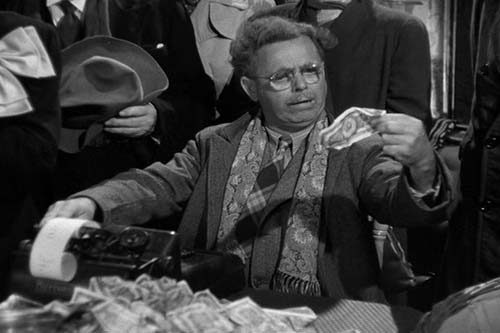
A couple of weeks ago, I was talking to my friend Dan about the ending of the classic movie It's a Wonderful Life -- where George Bailey's friends show up and dump a bunch of cash on the card table. Dan was wondering about what happened to all of the money. I reminded him that there's a shot of Cousin Eustace tallying up the haul on his adding machine, indicating that there would be a fair and complete accounting of all of the proceeds. It seemed like an interesting example of the efficacy of a single image in filmmaking, conveying a chunk of information in only a few seconds of screen time.


Lately, I've been feeling a bit like George Bailey, a man at the end of his rope, so to speak. Wondering if everything I've done was all for nothing. Thinking that I don't really count much in this world. Years ago, I came to Hollywood to fulfill my dreams, and despite my best efforts -- I seem to have come up short.
Way short.
It was a risk coming out here, but it was one I was willing to take. One I felt I had to take. But, here's the thing about risk -- sometimes you don't succeed. We've all heard the aphorisms, like, nothing ventured, nothing gained or fortune favors the bold or leap and the net will appear. But what about all of those who took a risk and failed miserably? Where are those aphorisms? How come they never mention that part? Win some, lose some doesn't really cut it. How about, win one or two, then lose everything? Sounds more accurate to me.
Sure, I've had a few successes. I had a pretty cool stint as a reality TV producer. But I got a little sidetracked over the past few years and the industry seems to have moved on without me. I feel like I may have missed my window. I've also been involved in several very promising projects, with some talented and hard-working people, but each one has foundered on the shoals of Hollywood indifference.
Risks taken, crickets chirping.
I guess the reason this was all hitting me at once was the fact that I was facing a pretty big birthday, a milestone birthday, though it felt more like a millstone to me -- weighing me down, crushing my soul, grinding my dreams into dust. Fun stuff.  I planned to go back east and visit my family, hoping that would help to minimize the feelings of dread and despair. But my family has suffered our share of misfortune the past few years and I wasn't really expecting a big celebration, or any celebration. Just being around them was all I wanted.
My sister had other ideas. She wanted my birthday to be special. She wanted me to feel special. That's what she does -- she takes care of people. She makes us feel special. So she contacted several of my oldest and closest friends and invited them to a party at her house. And... they came! They interrupted their own lives and traveled across state lines, crossing bridges and paying tolls and buying overpriced gas, to come to my birthday party. And my family was there and we had food and cake and prosecco (my sister loves prosecco) and presents and it was, well, wonderful.
As I stood in the kitchen surrounded by my longtime friends, some newer friends, and family members ranging from age 8 to 88, I felt like George Bailey -- but not the desperate, frightened George Bailey who jumps off the bridge -- I felt like the George Bailey at the end of the movie, "the richest man in town." George finds a book atop the pile of cash with an inscription from Clarence the guardian angel that reads: "Remember, no man is a failure who has friends." And that's exactly how I felt. Just like in the movies.

Meanwhile, I have this other friend here in LA who has spent his whole life working in the movie business. He's decided that after helping so many others make movies, it's time for him to start making them himself -- so he hired me to write a screenplay. Literally "hired" me, as in paid me money. It's the whole reason I moved out here in the first place. You might say it's a dream come true. Now, we're not talking a ton of money here -- probably a lot less than the pile on George Bailey's card table -- but, hey, I'll take it. And once we start production, he wants me to direct as well. Which is very, very cool.
So, at this point I would have to say that life is pretty good.
And sometimes, even wonderful.

Monday, October 28, 2019

Best Story Ever

Here's the wonderful Robert Forster sitting at his regular table at the Silver Spoon (where I met him) telling the story of how he met Quentin Tarantino, also while sitting at his regular table at the Silver Spoon.

Thursday, October 24, 2019

Table by the Window

The table by the window where I often spotted Robert Forster at Marco's in West Hollywood now sits empty.

Tuesday, October 22, 2019

Potemkin Nation

"Those who failed history are doomed to repeat it."
-Hollywood Dick

Last night I was watching Catherine the Great on HBO starring Helen Mirren -- who is also pretty great. I became interested in the character of Potemkin, who becomes Catherine's "favorite" and ends up (spoiler alert) having a lot of political influence. Potemkin is one of those historical figures whom I've often heard about but really never knew who he was. So I went online.
Turns out that one of the main things Potemkin is known for was convincing Catherine to annex the Crimean peninsula, making it part of Russia. If this sounds oddly familiar, it's because just about everything happening in American politics right now stems from a more recent annexation of Crimea by Vladimir Putin. See, after the Russian revolution in 1917, Crimea changed hands a few times until -- following the collapse of the Soviet Union -- it became part of Ukraine. Then five years ago, Putin invaded Crimea and made it part of Russia again. The US & the EU imposed sanctions on Russia, members of the Trump campaign made over 100 contacts with Russian officials, and hilarity ensued.
But back to Potemkin. In order to convince Catherine that annexing Crimea was a good idea and that everyone there was happy and prosperous, Potemkin arranged a series of staged installations during a visit she made to tour the area. He had fake villages erected, kind of like movie sets, painted in festive colors and populated with smiling residents -- for Catherine to observe along her route. Once she had passed by, the fake villages would be disassembled, packed up and moved to another location to be re-purposed for another leg of the tour. These ersatz hamlets came to be known as Potemkin villages, and the term Potemkin village has, in turn, come to represent a kind of facade or put-on used to disguise an undesirable situation or create the appearance of something valuable.
In the book The Art of The Deal, Donald Trump boasts about a stunt he pulled off while trying to impress some executives from Holiday Inn, whom he wanted to con into investing with him in a new casino. In order to make the executives believe that he was already engaged in active construction on a particular lot along the Atlantic City boardwalk, Trump ordered his construction managers to rent some heavy equipment and basically just move the dirt around -- digging holes and filling them up again. "What the bulldozers and dump trucks did wasn’t important," Trump said, "so long as they did a lot of it." Classic Potemkin move.
Now, there are those historians who say the stories of the Potemkin villages are apocryphal -- and by now we should all know better than to believe anything that Donald Trump says -- but one or two things are certain: 1) watching TV can be educational as well as entertaining and, 2) we are living in a Potemkin Nation where the bullshit never ends.

Sunday, October 13, 2019

The Cadillac of Actors

Back when I first moved to West Hollywood, there was a diner across the street from my building called The Silver Spoon. It was a regular bacon-and-eggs type of place with booths and a counter and tables and a cozy bar, and best of all, a covered outdoor patio. The patio was the perfect place for french toast and turkey sausage on a beautiful, sunny Sunday morning.
There was a guy who always sat at the back corner table on the patio, reading the paper -- one of those people you see in Hollywood who look so familiar you think you know them, until you realize he's an actor. This actor was Robert Forster. He was such a regular there, they even had a signed poster from the movie Jackie Brown on the wall.
Around this same time period I attended a wedding reception in Orange County where I found myself talking to a beautiful blonde who was asking me if I ever saw any movie stars in West Hollywood. When I mentioned Robert Forster, her eyes lit up. "I love him," she said. Turns out she had been an actress when she was younger, before getting married and moving to Orange County to raise a family. She told me that she knew Forster and that he had been the sweetest, kindest, most honorable man in all of Hollywood. Helping her out with advice and such. Of course I'm thinking 'who wouldn't want to help you out?' But she was so thrilled to be reminded of him she made me promise to tell him she said hello.
So, the following Sunday I was at the Spoon and when I finished my french toast I ambled over to Forster's table and apologized for the intrusion, but... And I told him about the blonde from Orange County. He was very polite, but had no idea who she was. He probably met thousands of beautiful young blondes in his day. He asked what she was up to now and I said she was raising a family and he said, "well, that's the most important thing anyone can do." Which I found kind of quaint, but also kind of cool.
And that's how I met Robert Forster.
Cut to a few years later, I was writing a screenplay called Stealing Tarantino, about a guy who steals a script from Quentin Tarantino, and I read about how Forster and Tarantino would meet at the Spoon on a regular basis to discuss Forster's character. So, I decided to write Forster into the script. When I finished writing, I pitched the script to an agent, who basically told me that a movie based on a real Hollywood big shot would most likely never get made, so the script got shelved -- along with so many others.
But I couldn't get it out of my head, and so one sunny Sunday, I was at the Spoon and I saw Forster at his usual table, reading the paper. I ambled over once again and apologized for the intrusion, but... And I pitched him the movie. He was tickled by the idea that I had set a scene at that very table with him playing himself helping the Tarantino character track down a bounty hunter he had used for researching a role. Then he told me he had a stack of scripts at home three feet high that he had to read, and another stack four feet high that he wanted to read. "Yours goes at the bottom of the four foot stack," he said, "that means I'm never gonna read it." He added, "But if you get a million dollars to make the movie, give me a call."
He actually did suggest I get in touch with his daughter, who was working as his manager at the time, and see if she would take a look. He didn't tell me her name or give me her number, and I didn't ask -- I just thanked him profusely and tried to make a graceful exit. I did manage to get hold of his daughter, and we traded emails -- she may have even asked me to send her the script. But, nothing ever came out of it. Still, it was nice of him to offer and nice of her to follow up.
When they tore down the Spoon to make room for a fancy fish place, Forster moved his "office" to a restaurant across the street -- always sitting at the table by the window. I'd see him there all the time, and once or twice I think he even recognized me. Maybe not.
Last night I watched him in one of his final performances, in El Camino, reprising his role as "Ed" the disappearer guy. Forster died the day the movie came out. He does his usual terrific job, giving the scene exactly what it needs -- no less, no more. As an actor, you never catch him trying to convince you of anything, he's just doing his thing, not giving away too much, but with a lot going on under the surface. He was a master.
There was another movie I saw him in once, I can't remember the name or what it was about, but at one point he's trying to convince someone what a good car a Cadillac is by reminding him that they use the term "the Cadillac of..." whatever something is to mean "the best of" --  and the Cadillac literally is "the Cadillac of luxury cars," so it must be the best. It's a funny scene with Forster playing up a midwestern accent that makes the word "Cadillac" a joke unto itself.
Robert Forster was the Cadillac of actors, the sweetest, kindest, most honorable man in all of Hollywood. Maybe someday people will use his name to describe "the best of," as in "he's the Robert Forster of optometrists."
I think he would get a kick out of that.

Monday, October 07, 2019

Burgers & Blockbusters

The other day, I was passing by a local burger restaurant which I never go to, when I saw a familiar face. It was my old friend Sonia, former owner of Irv's Burgers, a longtime favorite West Hollywood eatery which sadly closed its doors last year -- forced out of business by rising rents, taxes and insurance. Sonia now works directly across the street from the original Irv's location, where she'd thrived for over fifteen years before relocating up the street and then, ultimately shutting down for good.

The restaurant where Sonia now works is part of a chain that features overpriced megaburgers and overly-amplified live entertainment in the form of bingo, trivia, karaoke, etc. It's fairly popular, especially on the weekends, but it's far from the kind of place where you might stop in for a simple quiet meal and maybe a chat with one of your neighbors. It's more like a tourist trap.
Irv's is just one of several local restaurants that have fallen victim to the mindset that seems intent on destroying anything that makes West Hollywood feel like a community and transform it into an upscale clip joint. Decades-old, family run businesses keep getting squeezed out, only to be replaced by shiny but soulless franchises -- most of which are gone within a few years and replaced by even shinier franchises with even less soul.
I guess that's just the way of the world: things that feel familiar and comfortable and personal give way to those that are loud, bright and cheesy. Progress almost always turns out to be a ripoff. Everybody's trying to jump on the big new trend and make the fast bucks -- except most of them end up failing because trends subside and high prices and gimmicks don't build customer loyalty.
In Hollywood the latest big trend seems to be superhero movies. They're fairly popular, especially on weekends -- but to me they kind of feel like tourist traps. Or, as Martin Scorsese recently suggested, theme parks. Don't get me wrong, I love me a good theme park, it's just not the place I go to make a real connection to the human condition or experience masterful storytelling. Not that there's anything wrong with pure escapism, but it can only get you so far.
I used to frequent a restaurant in Burbank that sold the best breakfast burritos in town. That's what everybody said anyway. I went there for the turkey burgers. The place has been around for two generations and remains as popular as ever. Once I was talking with the owner about his competition, and he said his father always told him that competition doesn't matter. "They do what they do and we do what we do, and it's okay for all of us to share the same street."
Trends come and go. There's plenty of room on the street for big, escapist blockbusters and little, handmade indie flicks. Or there should be anyway. Just like there should be room for a cozy, family-run cafe just down the block from the flashy new flavor-of-the-month bistro.
Anyway, I am glad that Sonia's back in the neighborhood. But I sure do miss Irv's.

Sunday, September 29, 2019

Parallel Universe

Last night I was walking down the sidewalk, on my way to the store, when I saw a guy trying to back into a parking spot along the busy four-lane boulevard in front of my building. He wasn't doing a very good job. His first attempt had left his car sticking halfway into the right lane, causing a backup of about a dozen cars -- most of whom were trying unsuccessfully to get around him. Naturally, the cars in the left lane weren't having any of that, because LA. So, the hapless motorist pulled forward again to get a better angle on the situation and wound up backing into the curb at a nearly 45 degree angle -- creating an even bigger obstacle to the flow of traffic.
At this point there were at least twenty cars stacked up in the right lane, stretching all the way down the block and into the next. The guy looked flustered and panicky. His car was a new Lexus, and I couldn't help wondering why, with all the fancy 'driver-assistance' technology, the guy still sucked so bad at parallel parking.
 I continued walking down the sidewalk and crossed to the next block -- by now there were probably thirty cars stuck behind this moron. I thought about my dad teaching me to parallel park and how he wouldn't let me use the car until I'd learned how to execute the maneuver in one seamless move. It was part of the driver's license road test -- you couldn't pass if you couldn't parallel park. I thought everyone had to learn how to do it. How is it possible that a grown man driving in a major U.S. city could be unable to parallel park?
It turns out that California, along with several other states, no longer requires parallel parking in their road test. Why? The short answer: Because it's too hard. People kept failing the tests and had to come back and retake them over and over again, creating a backup at the DMV. You see the irony, right? To alleviate the backup at the DMV, they dropped parallel parking from the road test, thereby creating a backup on my street -- and probably hundreds of thousands of others.
More and more, we live in a world where being competent is no longer a requirement. The chief executive of the (formerly) most powerful nation on earth has literally no idea what he's doing at any given time. Having skills and knowledge and expertise are quaint notions that only exist in some parallel universe in the minds of a disappearing few. But it's cool, because now we have cars that can parallel park for you -- if you can figure out how they work. Or you could just take an Uber and not have to park at all. Soon we'll have cars that will do all the driving for you. Won't that be grand? We won't have to know how to do anything for ourselves. Just sit back and let the machines take over. What could possibly go wrong?
As for me, I think I'll just keep walking.

Monday, August 26, 2019

Cuck-a-Doodle-Doo

Thursday, August 30, 2018