Chapter One, "Sardines" Pattie and Warren tell the story of how they met.
Chapter Two, "Mount Vernon" (part 1 of 2) Pattie visits the neighborhood in Mt Vernon, New York where she grew up.
Chapter Two, "Mount Vernon" (part 2 of 2) Pattie visits the neighborhood in Mt Vernon, New York where she grew up.
Chapter Three, "Cromwell" Warren visits Cromwell, Connecticut where he grew up.
Chapter Four, "Northampton" (part 1 of 2) Pattie tours the former site of The Mary A. Burnham School in Northampton, Massachusetts.
Chapter Four, "Northampton" (part 2 of 2) Pattie tours the former site of The Mary A. Burnham School in Northampton, Massachusetts.
Chapter Five, "Middletown" (part 1 of 2) Warren explores Middletown, Connecticut home of Middletown High School and Wesleyan University.
Chapter Five, "Middletown" (part 2 of 2) Warren explores Middletown, Connecticut home of Middletown High School and Wesleyan University.
Chapter Six, "New York" Pattie talks about living and working in New York City.
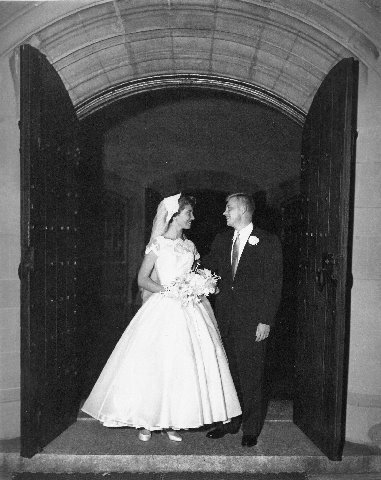
Chapter Seven, "Bronxville" Pattie and Warren visit the church in Bronxville, New York where they were married.
Chapter Eight, "Skytop" Pattie and Warren talk about their honeymoon at Skytop Lodge in the Poconos.
Chapter Nine, "Bridgeport" Pattie and Warren visit their first apartment in Bridgeport Connecticut and the old General Electric plant where they both worked.
Chapter Ten, "Derby" (part 1 of 2) Pattie and Warren take a tour of their first house in Derby, Connecticut.
Chapter Ten, "Derby" (part 2 of 2) Pattie and Warren talk about the births of their three children while living in Derby, Connecticut.
When I was a kid in elementary school, we had music class every day where we would sing songs from a book called Making Music Your Own, which I constantly misread as Making Your Own Music. There were a lot of classic American folk songs in the book, like Erie Canal, Big Rock Candy Mountain, John Henry, and Go Tell It On The Mountain. It was the early seventies and we were still caught up in the big folk music revival that had begun in the sixties. Plus none of the songs were copyrighted and so the textbook publishers didn't have to pay any royalties.
My favorite song in the book, in fact everyone's favorite song in the book -- in fact just about everyone's favorite folk song of all time, was of course, This Land Is Your Land by Woody Guthrie. In that song, Woody shared with us all his anarchic/neo-socialist ideal vision of America as a land that truly belongs to everyone. I always thought it was funny that they would put such a subversive song in a public school text book. Of course they did manage to leave out a couple of verses:
As I was walkin' - I saw a sign there And that sign said - no tresspassin' But on the other side .... it didn't say nothin! Now that side was made for you and me
In the squares of the city - In the shadow of the steeple Near the relief office - I see my people And some are grumblin' and some are wonderin' If this land's still made for you and me.
I guess they weren't ready to start filling our impressionable little minds with thoughts of civil disobedience or disillusionment. Who knows where that would lead?
I recently saw a documentary called Butterfly about a young woman named Julia Butterfly Hill, who spent two years living in a 180 foot tall redwood tree named Luna. Julia, and her team of supporters from a group called Earth First, were trying to prevent a big lumber company from cutting down the 600 year old tree. Julia lived in a 4 by 6 foot platform and withstood high winds, hailstorms, hostile loggers and bad press during her vigil. Some thought she was crazy, others thought she was a saint. In the end, the tree was saved.
Apparently, Julia and her friends at Earth First got hold of an unabridged version of Woody's famous anthem. Either that or they were just a bunch of troublemakers from the get-go.
I was truly inspired by this wacky chick who decided to forgo all logic and propriety, not to mention personal comfort and safety, because she had found something that she deeply believed in. I felt a little like the cynical shrink in the play Equus who envies his patient, a crazy kid who worships horses as gods, because at least the kid something to believe in, while the shrink has nothing. Maybe Julia is just a tree-huggin nutjob. But boy does she have passion and commitment.
I guess I used to be that passionate and committed. I've lived my whole life with the idea of becoming a great writer. Everything I did was part of my journey as an artist. There have been moments when I felt like I was completely on track. But there have been other moments when I felt like I am just going around in circles. Sometimes it seems like the circles are getting smaller and smaller.
How do you know if you are headed toward your goal, or if it is just an illusion? What if you are just some crazy kid riding naked on horses in the moonlight? Or a kooky old man tilting at windmills?
I saw another documentary recently (I seem to be watching more documentaries these days) this one was about Eugene O'Neill. Like me, O'Neill started out in Connecticut, spent some time wandering around, underwent a transformative realization while living in New York City, and eventually came to California.
Unlike me, O'Neill enjoyed a fairly successful career as a writer and was awarded a Pulitzer and a Nobel Prize. But despite his success, for most of his career O'Neill felt that he had failed to live up to his potential. He felt that he had greatness in him and wasn't sure if he would ever achieve it. By the time he came to California, his health was failing and he knew that his days as a writer were numbered. And yet he still had not produced the kind of work he had always hoped to create.
O'Neill and his wife moved into a house in northern California, called Tao House in a secluded setting surrounded by woods and views of the mountains. For a man who grew up on the Connecticut shoreline and spent most of his life near water, this new residence was as landlocked as he had ever been. He withdrew into a library on the second floor and began work on a massive cycle comprising 11 plays chronicling the history of an Irish American family over 100 years. But after completing only two of them, he must have realized that he would never be able to finish the entire cycle.
O'Neill abandoned the cycle and started anew. Over the next five years, he wrote five new plays, three of which, The Iceman Cometh, A Long Days Journey Into Night and A Moon for the Misbegotten, are considered among the best American plays ever written. Long Days Journey Into Night stands among the best works of literature of all time.
He knew he had it in him and he finally let it out. And it nearly killed him. For the final ten years of his life, he was physically unable to write at all. But he achieved greatness.
Sometimes I wish I had a room like O'Neill's library, secluded, surrounded by trees, with a view of the mountains, where I could achieve the greatness I feel is within me. Or even a platform way up in a redwood tree, clinging for dear life to the branches while the wind rips my tarps to shreds -- but at least I know I am doing something worthwhile.
Instead I have this tiny sweatbox in the middle of a city filled with people just like me, who think they are destined for something special, but maybe they aren't.
I guess it doesn't really matter where I am. As long as I am somewhere. As long as I am doing something. As long as I have my illusions, or delusions, or dreams, or whatever they are.
Woody Guthrie never gave up. He wrote a song nearly every day until he couldn't write no more. Julia Butterfly Hill never gave up. Even when the sky pelted her with hailstones for ten days in a row. Eugene O'Neill never gave up. Even when his hands were shaking so bad that he could barely hold the pen.
So maybe this room is my redwood tree, my library, my America. And I'm gonna stay right here. I'm not giving up.
I missed my high school reunion again this year. So far, I've missed them all. For the first one, which was after five years, I was in New York City at the White Horse Tavern with my good friend and high school classmate Dave Todd. After a few pints of Guinness, we got on the pay-phone and called the restaurant in Louisville where our class was holding its reunion. Surprisingly, we got through and ended up talking to several old friends. I remember talking to the woman who was my first true love, and the first girl to break my heart. She was now happily married, but not to the guy she left me for. It was good to hear her voice. I wished I could be there in person.
This year, thanks to cell phone technology, I was able to call my old buddy Gary while he was attending a big reunion party. Gary was one of my closest pals in high school and it was great to talk with him again. We had been exchanging emails in the weeks before reunion and had been able to catch up a little. When I called him at the party, he passed his cell phone around so I could catch up with some of the other folks there, including the girl who broke my heart. It was such a treat to hear that honeysuckle-and-magnolia Louisville accent once again. There are no women quite as sweet as Louisville women.
My 'Ex' passed the phone to another Louisville lovely named Jane Halliday who I've seen a few times since high school. Dave Todd and I used to take road trips to visit Jane at Smith when we were both at Wesleyan. And a couple of times, when passing through Louisville on road trips with Bob Sweeney and Dan Haar, we made it a point to stop and see Jane. The last time I saw her was at Dave Todd's wedding in Apalachicola, Florida. Jane is a very talented violinist who makes her living as a musician and still calls Louisville her home.
Ray Sharp was one of the people I really wanted to see. I hadn't seen him since I watched him set the world record in the one mile race-walk at Madison Square Gardens. But thanks to the flurry of pre-reunion emails that were burning up the internet last month, Ray and I got in touch again. He was coming west to visit his parents in Tucson and I decide to drive over and see them. I had driven to Phoenix last fall and it wasn't so bad. Of course driving to Phoenix in the fall is not quite the same as driving to Tucson in the summer. Turns out it gets quite hot in the desert in the summer. Even at night.
But the long hot drive was well worth it. It was really good seeing Ray again. We seemed to take up right were we left off. Ray and I shared many adventures in those early days. Perhaps the biggest one was when we both decided to leave college and drive from Louisville to San Francisco in the middle of one of the biggest ice storms in history. We were going out to try and track down our friend Mark Bush who had mysteriously disappeared a few months earlier. We weren't sure where to look for him, we just knew he was in San Francisco. By some odd combination of miracles and dumb luck, we actually found him out there. I stayed around for a couple of months living with Ray in a small apartment in Oakland. Eventually I went back to school. Ray stayed in California to devote his life to race-walking.
While in Tucson, Ray and I visited my old college buddy Mitch at the Santa Cruz River Park 'disc' golf course. (That's Frisbee golf to you and me.) Apparently 'disc' golf involves drinking a lot of beer (perhaps to combat the stifling heat) and sitting around listening to bootleg Grateful Dead tapes on the car stereo. At least that's what we did.
I stayed at Mitch's bungalow that night amidst his collection of neo-modernist furniture, all of which are rare originals. In fact every time you sit down in Mitch's house he whips out a catalogue from an auction house and shows you a picture of a chair just like the one you're sitting in and shows you how much it's worth. Makes you think twice about spilling your beer.
The next day I left Tucson at about 4 p.m., when the temperature inside my car had reached about 300 degrees, and drove nonstop back to Los Angeles where it was a merciful 85 degrees at 2 a.m.
It's been kind of strange reconnecting with all these ghosts from the past. When I got off the phone after talking to the people at the reunion, I was a little overwhelmed. I had wanted to go back and see them all, but after talking for just a few minutes I felt like I'd had enough nostalgia for a while. Or maybe it was just harder because they were so far away and we couldn't really hang-out together.
The next week it was sweltering here. (But not nearly as hot as Tucson.) I was busy trying to make some things happen in my screenwriting career but I wasn't getting much action. I had been sending out emails and making calls trying to attract some attention, but hadn't gotten any bites. I was sure that something was wrong with my email. I wasn't even getting any spam!
About the only person who did call me was my friend Ellen. We ran into each other at a party a few years back that was thrown in honor of Lauren Lazin's Oscar nomination. I walked into the kitchen and saw this girl from my high school standing there. But it couldn't be. Ellen? It was. Turns out Ellen is in the movie business and was friends with Lauren. Ellen came to L.A. right out of college and has been here ever since. I hadn't seen her since we graduated from high school, and she hasn't changed a bit. I know everyone says that, but it's true. O.K., she's changed a little, she owns a really nice house and is a senior VP at major movie studio, but other than that she's just like I remember her.
Ellen and I had talked about going back to the reunion together, but Ellen's job tends to take her all over the world and she wasn't sure of her schedule. I, on the other hand, have virtually no schedule at all. I did however have several important meetings with a bunch of producers the week of reunion. (One of them finally did call back, by the way.)
Anyway, after Ellen called, I realized that I'd already had my high school reunion when I ran into her at Lauren's party. But instead of seeing a bunch of people you barely remember for five minutes at a cocktail party, I got to reconnect with one person and get to know her all over again. And it's been great. We have a lot in common since we literally grew up together. But we also seem to share a similar perspective that we have dubbed 'being from Louisville.' It has to do with honesty and sincerity and courtesy and integrity, and generally being nice. We never realized how rare such qualities were until we started comparing notes. Sometimes it's a relief just to have someone else to talk to who was raised properly.
I'm lucky to have friends from high school that I still consider friends today. There's something about knowing someone from that time period that gives you a real perspective on who they are. Only your parents and siblings can know you better. In fact, considering how long it's been and how far we've all come, it's amazing how many of us are still in touch and still remain friends. My friend Mark Bush moved out here a few of years ago and I got the chance to visit him and his family several times before they moved back east. It just felt good to see him. We went through a lot of ups and downs together and after all that wears away, what's left is just the good stuff.
I guess I prefer to have my reunions on a one-on-one basis. It's a little more time-consuming, but way more satisfying.