It seems that whenever any white person gets caught doing something overtly racist, the first thing they do is get in front of the nearest TV camera and say, "I'm not a racist." Because no matter what you really think, the one thing you can never do is admit to being a racist. In fact, I bet if you did a survey of all the white people in America you would find that almost none of them are racists.
But I am.
For most of my life, I didn't know I was racist. My parents raised me to to treat everybody the same, just like Jesus. But we really didn't know any black people we could treat 'the same.' My Dad had one black co-worker at GE, whose son Eric went to my high school. We weren't really friends, but we were friendly. I remember once my parents had Eric's parents over to our house for a party. Apparently this created quite a scandal in our all-white Louisville neighborhood.
Even in the 'progressive' atmosphere of Wesleyan University, I didn't meet many black students. There were none in my freshman dorm. In the dining hall, all the black students sat together in one corner. Many of them lived in a 'special interest' dorm called Malcolm X House. I spent one evening at Malcolm X house with my friend Mark, who was dating a woman who lived there. I felt kind of like a tourist.
I spent some time in Texas where I worked construction with a black guy named J.J. for a while. We got along O.K. I went to his house once. Felt like a tourist.
When I lived in Washington, D.C., the only black people I knew were the legal secretaries and the guys from the mailroom at the prestigious law firm where I worked. There were no black lawyers there. The part of D.C. where I lived, called Northwest, was where almost all of the white people lived. Even on the subway, I was pretty much surrounded by white people every day. I don't recall that this ever seemed odd to me. Although I remember going to a Grateful Dead concert at RFK stadium one hot summer day with some Russians who were visiting America for the first time. At one point, one of the Russians remarked, "the only black people here are working here."
Sometimes it takes an outsider to point out the obvious.
After I left D.C., I moved to Brooklyn and lived in a neighborhood that was 'in transition'. That meant that white people were moving in and buying up the old brownstones and the black people had to move out. I now had actual black neighbors, including The Rev. Al Sharpton, who lived one block down. When I rode the subway into Manhattan every morning, there were as many, if not more, blacks than whites on the train. There were also Hispanics, Asians, Persians, Russians, Jews, Muslims, Gays, Lesbians, Transvestites, Homeless People, Crackheads, and Panhandlers. I was a long way from Louisville.
The law firm where I worked, which was Rudy Giuliani's old firm, actually had one black partner. For a few months I even had a black co-worker. He told me he got the job because he went to the same college as the black partner. He spent most of his spare time calling up other black paralegals and lawyers on a list he got from his alumni office. He was a networker. He had to be.
One night, I was coming home late from a movie. I had stopped off for a beer or two, so it was pretty late when I got out of the subway, just a few blocks from my apartment. I started to cross the street and noticed a black man waiting on the opposite corner. For a moment, I got nervous. 'What's he doing hanging out on the corner this late at night? Is he going to mug me?' Then I noticed that on the other corner was another black man talking on the pay phone. I immediately felt guilty. The first guy was probably waiting for his friend to get off the phone. (Because all black people know each other.) How racist of me to assume he was a mugger.
I continued across the street and down the sidewalk. As I did, I heard the second guy hang up the phone and walk towards the first guy. A moment later I heard the scuffle of shoes on concrete coming from over my right shoulder. Before I had a chance to process that information, I had an arm around my neck and I was gasping for breath. It was a big arm, a muscular arm, a black arm.
A voice behind me said "Don't do nothin'." I wasn't about to. The second guy quickly searched my pockets and took my wallet. I think I may have tried to say something, but I couldn't speak. Or breathe. Suddenly, the lights went out.
When I opened my eyes, the world had gone cockeyed. There was a tree growing out at a right angle from the wall I was leaning against. My head felt warm. My glasses were gone.
It took a full minute for me to figure out that I was lying on the sidewalk. My attackers were long gone. My glasses were next to me, unbroken. I tried to stand up, but the sidewalk was tilting back and forth. I sat there for a while. The street was completely deserted. Eventually, I got up and walked home. My head was pounding from the huge bump I'd received from being dropped onto the concrete. But I was alive. And that was something.
I called the police and they took me to the hospital where I sat in the waiting room for what felt like hours. Then someone led me to a room with an x-ray machine and had me lay on a steel table. I was in there for another twenty minutes before they let me go. The technician kept pressing my head against the table to get the x-ray. I told him that the reason I was there was because I had a big goddamn bump on the back of my head and that when he pressed my head against the steel table it really, really hurt. He did not seem concerned.
By the way, for the record, the cops and the x-ray tech were white.
I had to wait for a white doctor to look at my x-ray before they let me go home. It was now about four a.m. I had no money and no-one to call to ask for a ride. I was deep in the heart of Bedford-Stuyvesant, one of the toughest neighborhoods in Brooklyn. That means that only low-income black people live there.
The two mile walk from the hospital through Bed-Sty to my apartment in the pre-dawn darkness was one of the longest journeys of my life. My only consolation was that, if I were to be mugged again, I had nothing left for anyone to steal.
So I had that going for me.
For the next couple of months, I was a little freaked-out. Apparently I was suffering from a mild form of post-traumatic stress brought on by the combination of the mugging and the head injury. Since, as a temp, I had no health insurance, I had to rely mainly on the advice and comfort of friends and co-workers during this period.
The good news was, I did get my wallet back. Apparently the muggers tossed it onto a rooftop after removing the twenty dollar bill I had gotten from an ATM less than an hour earlier. Someone found it and turned it in to the police. All in all, I hadn't fared too badly. Little bump on the head, loss of twenty bucks, replace my credit cards -- not exactly a catastrophe. But there was one lingering effect.
A couple of weeks after I was mugged, I was riding the subway. A black man got on and stood next to me. I was sitting and he was standing, so his forearm was right at my eye level. It was a big arm, a muscular arm, a black arm. The sight of that arm sent me into an instant flashback -- I couldn't breathe, my heart was pounding, I felt dizzy and sick. Not until he moved away did I begin to feel better. He was a complete stranger to me. And I hated him.
Months later I was walking down a gravel path when jogger came up behind me. I heard the scuffle of his footsteps coming over my right shoulder and I froze in fear -- expecting to see that black arm encircle my throat. But it passed.
That was many years ago. Fortunately, I no longer freak out when I see black men with muscular forearms. I do still get a little jumpy when I hear footsteps over my right shoulder, though.
So, the other night I was walking down Santa Monica Boulevard. Not late. Not deserted. Shops and restaurants were open, cars passed by. Just ahead of me was a solitary black man, walking in the same direction. I guess I was walking faster than he, because I drew closer to him as we neared the corner. But then, he stopped walking and moved over to the side, by the entrance to a tailor shop. I couldn't help thinking he was specifically waiting for me to pass, but I wasn't sure why. As I went by him and stepped into the street, I glanced back over my right shoulder and noticed he was walking again, right behind me.
The same feelings of suspicion overcame me. 'Why is this guy following me? Is he going to mug me?' And as before the suspicion was immediately followed by guilt. 'Am I afraid of him just because he's black? Am I really such a racist?'
And the answer is, "yes." I was afraid of him because he was black, just as he was probably afraid of me following him because I am white. No matter how hard I try to force myself not to prejudge people, I do it anyway. I do it all the time. I do it even when I think I'm not doing it.
When I saw the two black men hanging out on the corner in Brooklyn, I was nervous because they were black. Then I felt guilty, also because they were black. I made an error in judgment that night because I was so concerned about them being black that I forgot about the fact that they were TWO GUYS HANGING OUT ON THE STREET CORNER IN BROOKLYN AT TWO A.M.
Every time I tell this story, it is always the story of how I was mugged by two black guys. But that's not what happened. I was mugged by two MUGGERS. Why do I need to mention that they were black? Because, apparently, I see black people differently than I do white people. Whether they are muggers or lawyers or construction workers or secretaries or students or just some guy walking down the street. I see them as black first, people second. I do.
So, I think the first step in becoming a post-racist society is not electing a black president. The first step is realizing that we elected a president, who happens to be black. And we did it despite the fact that we are all still racists. Well, I am anyway.
Where's the TV camera?
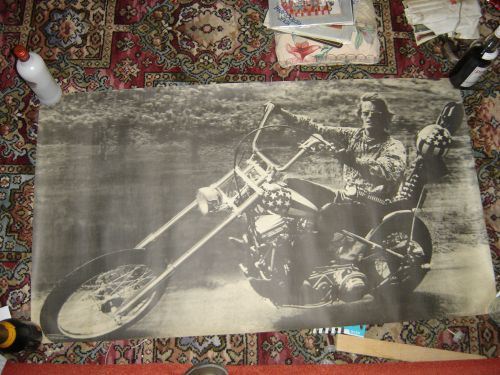
 "If you believed they put a man on the moon..."Somewhere, stashed away among the archives of my past, is the age-yellowed front page of the Louisville Courier Journal from July 20, 1969 featuring a color photo of astronaut Buzz Aldrin standing on the surface of the moon. I had that front page taped to the wall of my bedroom for years, along with my posters of Joe Namath, Peter Fonda and Raquel Welch. The posters are long gone, but I've been hanging onto that front page for forty years. I remember thinking that one day it would be a valuable piece of history. And I guess I was right, but not in the way I had imagined.
When I was a kid, space exploration was pretty much the coolest thing in the world. And it had nothing to do with beating the Russians or conquering the universe. It was about dreams and adventure and excitement: "to boldly go where no man has gone before."
Obviously TV shows like Star Trek and movies like 2001: A Space Odyssey played a big part in my fascination with space travel, but it was the reality rather than the fantasy that originally captured my attention. During one of our summer vacation trips to Florida, my family visited the Kennedy Space Center in Cape Canaveral, then known as Cape Kennedy. We toured the gigantic Vehicle Assembly Building where the Saturn V rockets were assembled, and stood beside the massive 'crawler' that transports the rocket to the launch pad. The sheer magnitude of these engineering marvels gave rise to the belief that, in this amazing modern world, almost anything was possible.
That belief was confirmed on July 20, 1969, when Neil Armstrong uttered those famous words, "One small step for man... one giant leap for mankind."
I had been following the mission with great interest, from the thrilling liftoff on July 16th, through the amazing 280,000 mile voyage from the earth to the moon. The night of the moon landing, my parents let me camp out on the floor in front of the TV with my blanket and pillow, to watch the incredible event. I must have fallen asleep a couple of times, but I do remember seeing Armstrong come down that ladder for the first time and kind of bounce down onto the dusty surface of the moon. It was like a dream come true. A man was actually walking on the moon! We had really done it.
The next day I couldn't wait to see the color pictures in the paper, even though I was still pretty bleary from my first all-nighter. I grabbed a pair of scissors and cut off the front page to hang on my bedroom wall in a place of honor. Today the moon, tomorrow -- who knows? That was the beauty of it. We could accomplish anything. And we would.
Less than a year later, however, our confidence was shaken by the nearly disastrous accident that befell Apollo 13. Although, as Ron Howard's excellent retelling of that event in the movie Apollo 13 shows, our ingenuity, intelligence and perseverance ultimately prevailed. But it was, no doubt, an object lesson in how dangerous things really were "out there."
But we kept learning and kept trying and, pretty soon, we were driving cars and hitting golfballs on the moon.
At some point during this period, on a trip to Washington D.C., my family visited the National Air and Space Museum. We got to take peek inside one of the Apollo command modules and stroll around a mock-up of the Lunar Excursion Module, the wacky looking bug-like contraption wrapped in gold foil that ferried the astronauts to and from the surface of the moon. And, of course, we saw the moon rocks. The fact is, the moon rocks did look a lot like certain earth rocks. Not like any rocks we had in Kentucky, mind you, but maybe like they had in Hawaii or New Mexico. But they were moon rocks! From the MOON! It was pretty amazing.
Of course it did not take long for the naysayers to start claiming that we had never really gone to the moon -- that the whole thing was just a hoax, a conspiracy. I never understood why anyone would believe that the moon landing was a hoax. First of all, why would you go to such lengths to fake a moon landing just to say you beat the Russians, and then repeat it five times? And why would you fake a failed mission to the moon?
But it was the era of Vietnam and Watergate and people did not believe in anything anymore. Anything good was phony and anything bad was true. It became cool to think that everything was a joke. Going to the moon was a big waste of time and money. What the hell did we want to go there for anyway?
Now of course, the idea of going to the moon seems quaint. Something dreamed up by a bunch of nerdy guys with crew cuts and short-sleeved oxfords. How silly. We should use our technology to make better phones and video games and stop wasting time on lame science fiction.
Yesterday, however, I watched the spectacular launch of the Space Shuttle Endeavour from Cape Canaveral and I must admit it was still pretty thrilling. And as it turns out, those nerdy guys from NASA never have given up on the dream. In fact, my cousin Randy is one of them. He's part of the team developing the next generation of manned spacecraft, called Orion. They are planning to go back to the moon in about ten years or so. And then maybe to Mars. And after that, who knows?
I guess my old, yellowed front page from July 20, 1969 is a valuable historical artifact. Maybe not to the rest of the world. But it still reminds me of the importance of having a dream and doing everything in your power to make that dream a reality.
Because the real 'final frontier' is the imagination.
 "Alright, alright, alright..."
I had to get my car 'smogged' the other day. Normally this wouldn't be a problem -- my car tends to run pretty cleanly. But two years ago when I went in for my certification, my 'check engine' light was on, and that is an automatic 'fail.' They had to give me a tune-up, to the 'tune' of about two hundred dollars, before my car could pass the test. Funny thing is, the damn light came back on a couple weeks later and has been on ever since.
So, this time I went to get my engine 'checked' before my smog test. Once again, I had to shell out a couple hundred bucks to address the issue. And this time, I was told that I needed to drive the car sixty miles before I took the test -- in order to reset the 'check engine' light. The shop I went to last time never mentioned this. That could explain why the light came back on so soon -- they never really fixed the problem.
I have since changed mechanics.
Because I tend to put things off till the last minute, I had to make a sixty-mile road trip in order to reset the 'check engine' light before I missed the smog test deadline. I searched Google for a map showing a thirty-mile radius from my house.
As it turns out there is such a map.
I found a very specific map showing the entire greater Los Angeles area lying within a thirty-mile radius measured from an intersection about a mile from where I live. It's called the Thirty Mile Zone and it refers to the limit which union members in the 'industry' can be expected to commute without being paid travel expenses. Consequently, most television and movie production takes place within the Thirty Mile Zone. And the center of the TMZ (aka 'studio zone') is the intersection of La Cienega Blvd. and Beverly Blvd. (aka 'center of the universe'), which is a mere three-minute drive from my house.
And yes, that is whence the celebrity gossip website TMZ.com derives its name.
Looking at the map, I couldn't help noticing that the outer edge of the TMZ passes right through Malibu: The perfect destination for my little road trip.
My first trip to Malibu was over ten years ago with my buddy Brian. At that time, the famous Malibu pier was closed for repairs. We had some pizza and saw part of a documentary about the Malibu surf scene that featured iconic surfers Lance Carson and Miki Dora. Back in the Fifties, the Malibu surf scene was known only to a select few. Guys with names like "Tubesteak" and "Moondoggie" lived in grass shacks on the beach and dodged the cops when they weren't riding waves.
All that changed when a young girl named Kathy Kohner arrived on the beach one day, towing a surfboard nearly twice her size. Kathy wanted to learn to surf and she wasn't about to let her diminutive stature, or her gender, get in her way. The surfers tagged Kathy with the nickname 'Gidget,' short for 'girl midget.'
Kathy kept a journal of her Malibu adventures, which her father, who happened to be a screenwriter, turned into a book. The book became a series of movies and a TV sitcom. And Malibu was never the same again.
This time I decided to delve a bit deeper into the Malibu mystique. I visited a place called the Adamson House which occupies the land between the Malibu Lagoon and Surfrider Beach. Originally the land was a Chumash settlement. They called it "Humaliwo" which means 'the surf sounds loudly.'
The Spanish first arrived in Humaliwo in 1542, but did not return again for over 200 years. When they did come back, they established a mission on the site and the Chumash got 'Christianized.'
Eventually, the land came into the hands of the Rindge family who fought several long, losing battles with the state of California to prevent construction of the Southern Pacific Railroad and the Pacific Coast Highway. The Rindges had at one time owned all of what is now known as Mailbu, but after losing so many legal battles, the widowed Mrs. Rindge was forced to sell off the property bit by bit. One of the tracts she sold became the Malibu Colony, an enclave of movie stars who wanted a retreat away from Hollywood. The Rindges also built the Malibu Pier, which was where they used to park their yacht.
When she started running out of cash, Mrs. Rindge began looking for oil. Instead she found mud. But not just any mud -- Malibu clay, which was ideal for tilework. She established a tile factory and created some of the most prized tiles in the world. The Adamson House is filled with decorative tilework both inside and out and is sometimes called the Taj Mahal of Tile.
I wandered the grounds for a while admiring the tile and spectacular view, but I still had a few more miles to drive until I reached my thirty-mile mark.
I decided to cruise up Malibu Road and get a look at the Malibu Colony. I pictured a kind of funky, ramshackle place where guys like Hal Ashby and Robbie Robertson used to live. But now it is just another gated community for big stars like Tom Hanks and Howie Mandel.
I continued north on Malibu Road. I used to know a guy who lived up along there. He was in a group of hikers that used to get together every weekend. We called ourselves Hike Club. One afternoon, following a long, hot hike in Solstice Canyon, we gathered at his beach house to cool off. Well, it was really his dad's beach house, but he lived there, too. It was pretty great, sitting on the deck, sipping a beer, watching the pelicans fly by. Later, we went for a dip in the Pacific. Very refreshing.
It's a nice way to live.
I think that's why I like the show Two and a Half Men so much. If I can't have my own Malibu beach house, I can at least pretend I live in Charlie Harper's Malibu beach house for a half-hour every week. Or every night, thanks to syndication. I even bought a couple Charlie Harper style bowling shirts at the thrift store. It's not quite the same, though.
At one point as I was heading up Malibu Road, I saw what appeared to be an opening that provided access to the beach. You rarely see the beach in Malibu. The houses are packed in so tight that a gnat couldn't squeeze through. Even though, legally, the beach belongs to everyone -- access to the beach generally belongs only to the rich folks. But thanks to group called Access For All, there are now dozens of public accessways leading to the beach.
Even in Malibu.
I happened to find one of these public easements nestled between two huge homes about halfway up Malibu Road. I walked down to the beach where one of the homeowners had tacked up a sign indicating that the area extending 25 feet seaward, to the mean high-tide line, was private property. Since the water was almost up to where the sign was posted, I wondered exactly where I was supposed to go. It didn't matter too much, though. Many of these homes were damaged in last year's fires and are in the process of being rebuilt. So I was free to roam the beach without stepping on anyone's toes.
So to speak.
After a brief walk on the beach, I headed up to the PCH and turned south. I immediately passed by the Malibu Bluffs Park and decided to stop in and take a look around. As I wandered the trails along the bluffs -- overlooking Malibu Road and the houses I'd just driven past -- I began to feel quite at home in Malibu. Like I belonged there. I could easily imagine a brisk morning run along the bluffs followed by a cool dip in the ocean. That's the way life was meant to be.
All I need is $15 or $20 million for a beach house.
Maybe someday I'll get that beach house. Or maybe just rent one for a while. I guess until then I can always watch another rerun of Two and a Half Men and pretend I'm Charlie Harper.
I already have the shirts.