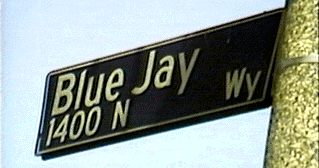
There's a fog upon L.A. And my friends have lost their way They'll be over soon they said Now they've lost themselves instead. There's a street way up in the Hollywood Hills called Blue Jay Way. About 40 years ago, when the Beatles were touring the U.S., George Harrison was staying at a house there. One foggy day he was waiting for some friends to come visit him and they got lost. So, while he waited, George sat down at the Hammond organ and wrote a song called, appropriately enough, "Blue Jay Way." It's not a very well-know Beatles song. It showed up on the Magical Mystery Tour album, which was one of those albums that only real hardcore Beatle fans bought. It's kind of a weird song about a sleepy guy sitting around waiting for his friends.
Nevertheless, I've always wanted to go to Blue Jay Way and see the house where George stayed when he was in L.A. I'm not sure exactly why I wanted to go there. I just liked the idea of George Harrison hanging out in this house in the hills and writing a song about it. So, a couple of weeks ago I went searching for Blue Jay Way, with very little to go on in the way of directions other than that you go up on Doheny and turn right on another street named after a bird.
As it turns out, there are about a dozen bird streets that wind around the Hollywood Hills near Doheny. There's Oriole, Thrasher, Warbler, Wren, Blue Bird and a bunch of others. And since I was on foot, it took me a long damn time to explore them all. Plus the hills get pretty steep up there and it was a hot afternoon and I was getting really tired and severely winded. By the time I got to the end of Oriole, which turned out to be a dead end, I was ready to give up. But as I was coming back I happened to look up Thrasher and I saw a sign that looked like it might say "Blue Jay" on it. I'd already been fooled by Blue Bird, so I didn't get my hopes up to high. But as I got closer, I saw that sure enough, I had finally found it. I was very pleased with myself for sticking with my quest. Even an arbitrary goal can have meaning if you let it.
Now to find the house. I had nothing to go on there, just that it would be one of the older houses and had a view of the city. I figured there would be something special about it that would tell me which one it was. I didn't think there would be many to choose from, because I'd read that Blue Jay Way was actually a cul-de-sac. Which it is. Eventually. First, though there's another half-mile of steep uphill grade, with dozens of 50's and 60's style houses that have city views. Still I persevered to the top. I actually had to stop about halfway because I literally ran out of breath. When I made it to the top there was a grand view of the hazy L.A. basin, but no spiritual epiphany, no flash of insight, no enlightenment. Just the realization that now I had to walk all the way back down. And don't kid yourself, walking down steep hills is strenuous work.
When I got back down to Sunset Blvd., I stopped at a cafe and guzzled a bottle of water. I don't know which house George stayed in, but I kind of picked one out and imagined it was the one. I thought about what it would be like to live way up there, looking down on the whole city every day like you were living in the clouds. I've always thought it would be really cool to live in the hills. When I'm on my street, I look up there and think about how someday I'll be up there too. It's fun to think about. I wonder if it's as cool as it seems.
I think about Blue Jay Way a lot too. I'm not sure why. It's kind of taken on a mythical status. I think about making another pilgrimage up there at some point. But maybe not. Maybe its just a state of mind. Maybe it's one of those moments in time where life just seems to make sense for no particular reason. Finding Blue Jay Way had no other meaning than the meaning I gave it, but that was all the meaning it needed. Blue Jay Way is perfect because it is what it is. Knowing that it is there makes me feel like things are O.K. It's just a street with a pretty name and a nice view, but sometimes that's all you need.
The Supreme Court did what it does best yesterday by sidestepping a controversial issue based on a legal technicality. By overturning the lower court's decision the Supremes preserved the current wording of the Pledge of Allegiance which includes the phrase "one nation under God." Is it a mere coincidence that they handed down their decision on Flag Day? And not just any Flag Day, but exactly 50 years since Congress added the words "under God" to the pledge in the first place. It was the same act of Congress that added the phrase "In God We Trust" on all our money. Why did Congress feel the need to do this 50 years ago? Because in 1954 we were in the midst of a Communist witch hunt and since everybody knows that Communists are Godless atheists, then it seemed only natural for us red-blooded, God-fearing Americans to proclaim our pro-God affiliations on the most sacred of all places: our money. And, as if that weren't pious enough, we stuck "under God" in a pledge mumbled by millions of sleepy children every morning as they begin their state-sponsored cultural indoctrination programs (i.e., public school). That sure showed them Commies.
By the way, before Congress changed our motto to "In God We Trust" it was "E Pluribus Unum" which means "One From Many." Sounds suspiciously Communist if you ask me. That's the problem with Latin mottoes. Nobody knows what the hell the mean. I've heard several different translations of "Novus Ordo Seclorum" including "New World Order," "New Secular Order," and the government-sponsored version, "New Order of the Ages." Then there's "Annuit Coeptis," which no one understands completely since it is obviously some kind of secret Masonic/Illumnati code that probably gives the location of their subterranean headquarters where they practice their Luciferian sexual rituals and spank each other with paddles carved from acacia wood. But I digress.
Personally I don't remember saying the pledge after sixth grade. I don't know why it is only in grade school where the pledge is recited. Maybe because when you're that young you'll say just about anything if it's repeated often enough. I do know that it took me a long time to figure out what the word "indivisible" really meant, and that it had nothing to do with our country's ability to disappear from sight whenever threatened by foreign invaders. Cool idea though. The Russians decided to attack us and all of a sudden we're "one nation (under God) INVISIBLE..." Now that's something to brag about!
Once I finally did begin to decipher what this "pledge of allegiance" was all about, it filled me with questions. First of all why am I pledging allegiance to a flag in the first place? I get the part about "and to the republic, for which it stands," (which by the way is one of the rare occasions where we Americans admit that we don't live in a democracy). I'm not saying I'm in favor of the idea of having a bunch of innocent, defenseless, politically unsophisticated schoolchildren promising to mindlessly devote themselves to an abstract governing entity that may or may not have the ability to become invisible at any given time. I'm just saying that I understand what it means. But the first part, the part about pledging allegiance to a flag ... to a flag? What the hell does that mean? I never got that and I still don't.
Now don't get me wrong. I grew up with plenty of respect for the flag as a symbol. We hung a flag outside our house on appropriate holidays in conformance with the proper etiquette: never after sundown, never in the rain, never let it get tattered or dirty. That's just basic respect. Not like you see now with people driving around with faded, tattered flags hanging out of the backs of their SUV's. I'll bet none of these patriots has taken the time to look up U.S. Code Title 4, Chapter 1, Section 7, Paragraph (b), which states, "The flag should not be draped over the hood, top, sides, or back of a vehicle or of a railroad train or a boat. When the flag is displayed on a motorcar, the staff shall be fixed firmly to the chassis or clamped to the right fender." (This does not apply to Lakers flags.) Or better yet Section 8, which prohibits the flag from being used in advertisements or printed on paper napkins or plates or part of a costume or athletic uniform or cushions or handkerchiefs. And how about this: "The flag represents a living country and is itself considered a living thing." And finally: "The flag, when it is in such condition that it is no longer a fitting emblem for display, should be destroyed in a dignified way, preferably by burning." That's the law folks. Burning flags is the law.
So, I guess what I'm saying is, I got no problem with respecting the flag, waving the flag, being proud of the flag. It's cool. I know I complain about this country a lot, but I still like it. But I do have a problem with pledging allegiance to a flag. You have to draw the line somewhere. And as far as the whole "under God" issue you could go on forever debating the intentions of the framers of the Constitution when they wrote that the government shall not "establish" religion. Why go there? The Supremes have already said that kids are not "required" to recite the pledge. So my recommendation is that if anyone doesn't like the Pledge of Allegiance, they should just do what I did when I was a kid and make up their own:
"I pledge all legions to the flag of the Divided States of America and Tudor Republics for which they stand one nation, underground, invisible with slippery injustice for all."
There's a scene in the movie Tin Cup where Kevin Costner is standing on the fairway of the final hole of the U.S. open. Three times previously we've seen him in the exact same situation, attempting to hit a long shot over a water hazard onto the green when the smart play would be to "lay up" and make the green in two. And each of the three previous times he has gone into the water. But Costner knows he can make that shot and despite the fact that he actually has a chance to win the Open if he plays it safe, he can't back down from the challenge. He hits the shot and it's a beauty, sailing over the water and landing within striking distance of the pin. The crowd cheers.
But then the ball begins to roll. And it isn't rolling towards the hole, it's rolling back down towards the water. Slowly at first, but gradually picking up speed as it nears the edge of the green. Maybe it will stop before it reaches the embankment. But no, it keeps going and plops into the drink.
Costner watches in agony. But he can still salvage the hole if he takes a drop and makes par. Maybe he can even tie it up and force a playoff. That would be the safe thing to do. But he shakes his head and asks for another ball. He's going to play it from the same spot. Because he knows he can make it. He hits again and the same thing happens. The ball dribbles down the green and into the pond. Costner doesn't even hesitate. He asks for another ball and hits from the same spot again. Before it even hits the water he asks for another. That one falls short too. Now he's down to his last ball. He gives it a good solid whack and it clears the water lands on the green and rolls into the hole. The crowd goes nuts. Here he has just blown a chance at winning the U.S. Open, but no one seems to care. He made the damn shot, just like he said he could, and that's what counts.
I watched that scene yesterday and, even though I've seen it several times before, I still get completely caught up in it. I think what I like about it is the way it all comes down to his belief in himself. He knows that he's capable of greatness, even though to everyone else he's just a burned-out loser who works at a driving range in the middle of nowhere. And when it comes down to a choice between laying up or going for the green, he has to choose the longshot. He calls it his defining moment.
Sometimes I wonder if I should stop shooting for the green and just lay up. Why do I have to keep going for the longshot? I'm sure life would be a lot easier if I just took my par and went home. It's not like I have to prove anything to anybody. Besides, it seems like every time I get close to the pin, my ball always rolls back down the hill and splashes in the water. Maybe it's just not worth it.
I heard from Victoria Wisdom the other day. I had sent her a brief synopsis of my screenplay and she sent back a little note explaining that "inside Hollywood" stories are hard to sell. In other words, she's not interested in reading it. I can't really argue with her. I doubt anyone knows more about what sells in this town than she does. But I really thought if she read it, she'd see that it was worth taking a chance on. It's funny because when I wrote it, I actually thought it was a really marketable idea. In fact most people I tell about it think it sounds great. But the reality is there are certain kinds of scripts that sell and this one just doesn't fall into any of those categories.
But damn it, I know I can make that shot. I took a chance with Victoria because I thought this script was worth the risk. You don't want to use up all your favors on a script that isn't going to go anywhere. She did me a big favor by allowing me to bypass all the usual obstacles and pitch my idea directly to her. Unfortunately my pitch wasn't strong enough to stay on the green. But I've got to take another whack at it.
On Friday I ran into a lawyer I used to work with. He asked me what I was doing and I mentioned the screenplay. Turns out he just won a big case for an agency called Bender-Spink and says he is pretty tight with them. Maybe I should send him the script and he can pass it along to them. A half hour later, I hand delivered a copy to his office. Bender-Spink has the reputation for taking risks with unknown writers. They also like to produce their own projects.
I know it's a longshot -- but hell, if you aren't going to play the longshot, what's the point of playing the game?