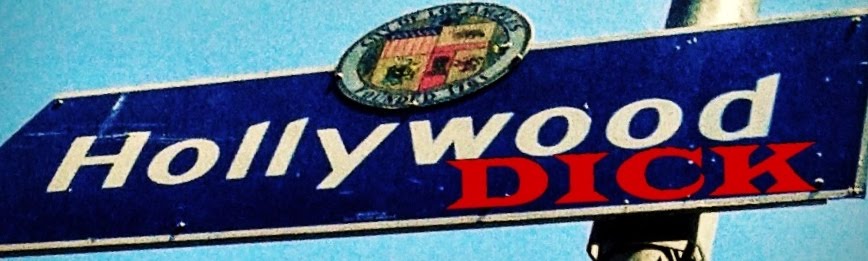
A few years back, I was eating breakfast at Barney's Beanery when I noticed that sitting right across from me was famous geek/hipster Quentin Tarantino. He was busily scribbling in a spiral notebook, which he left sitting on the table during a visit to the men's room. Though tempted, I restrained myself from peeking at his work in progress on the grounds that it would have been "uncool."
A year or so later, after watching the latest of Tarantino's excessively violent and pointlessly referential movies, I came to regret that I hadn't stolen the spiral notebook and destroyed it. I wrote about my encounter and the ensuing feelings of remorse in my monthly newsletter to share my experience with the Hollywood Dick community. I received an astute reply from David Hamburger, who said, in effect "Dude, you should make that your next screenplay!"
So I did.
Thus was born "Stealing Tarantino", my screenplay about a hapless screenwriter (all of my main characters are hapless, by the way) named RICHARD who steals a notebook from a famous filmmaker, known only as THE DIRECTOR. The notebook contains the only handwritten copy of THE DIRECTOR's latest screenplay and is therefore invaluable. RICHARD thinks he can use the notebook as a bargaining chip to get THE DIRECTOR to read one of his (RICHARD's) screenplays. He believes that if he could only hurdle past the army of hacks and wannabes that stand between him and the true artists of the industry, he will finally be recognized as the talented writer he believes himself to be.
Of course, THE DIRECTOR is in a panic and hires an investigator named MAX to hunt RICHARD down and get the notebook back. Meanwhile, an unscrupulous studio head (redundant?), who gets wind of the situation, hires an enforcer named MR. BLACK to get hold of the notebook for himself. He plans to hold onto it and force THE DIRECTOR into breaking their deal so he won't have to pay him what he owes him.
It all ends up in a three-way Mexican standoff in front of a local movie theater. The third party in the standoff arrives in the form of a jaded former actress who holds a grudge against the studio head and wants some payback. She forces RICHARD to give the notebook back, but not before THE DIRECTOR tells him what he thought of his screenplay. Turns out he didn't think it was all that great. Not exactly what RICHARD was hoping for.
But then of course, there's a twist.
In preparation for writing the screenplay, I watched all of Tarantino's movies and read all of his scripts. I also read several books about him and numerous articles and interviews. I watched various movies known to have influenced Tarantino, such as Bande à part and Die xue cheng shi. I watched as many of Tarantino's TV appearances as I could get my hands on as well as movies where he appears as an actor. I immersed myself in Tarantino's world. I visited places that loom large in his legend, such as 1822 S. Sepulveda, where he worked as a clerk at the Video World (which is no longer there, by the way.) I tried to think like Tarantino and, most of all to write like Tarantino.
The screenplay is filled with Tarantino references. Many scenes are parodies of scenes in Tarantino movies. Characters are named after characters in his movies. Dialogue is often lifted from his movies. At one point, THE DIRECTOR goes to see his buddy BOB at the Silver Spoon cafe, which happens to be across the street from my apartment. BOB is based on the actor Robert Forster whom Tarantino first approached to appear in the movie Jackie Brown while the two were having breakfast at the Silver Spoon. Forster's character in Jackie Brown is a bail bondsman named "Max."
There are numerous other references to Tarantino's movies and his life in the screenplay. How better to satirize the work of a director who is so well known for his references to other films? But a funny thing happened as I was working on the screenplay. I had intended to write a parody basically to make fun of all of the "borrowed" ideas, inside-out cliches, pop-culture references and flaky dialogue for which Tarantino movies are famous. But I soon became very impressed with the way Tarantino takes all of these bizarre ingredients and blends them into something wholly original, extremely well-crafted and highly entertaining. I became a fan.
When I finished the screenplay, I was convinced it was the best thing I had ever written. I had broken out of the restrictive set of habits that had limited my writing in past efforts. And I had Tarantino to thank for that. Whenever I was stuck on a scene or a particular line of dialogue, instead of following my own instincts, I thought, "what would Tarantino do?" In most cases it was the opposite of what I would have done.
I showed the screenplay to a few friends and they agreed that it was a breakthrough. I was confident that this was the screenplay that would finally get me noticed. I decide to try and show it to a succesful Hollywood Agent I had met recently at a party. She happens to be the person who "discovered" and helped develop one of my favorite screenplays, The Usual Suspects.
I met with The Agent one evening at the Writer's Bar at L'Hermitage Hotel in Beverly Hills. She was there to hear me pitch a series of screenplay ideas and help me decide which one to focus on. While we were there, a beautiful dark-haired woman in a cream-colored suit came in and sat down at the table directly across from me. It was Angelina Jolie. She sat there all by herself eating chocolate-covered strawberries and sipping champagne while I tried desperately to concentrate on my movies. As if I wasn't already nervous enough. The Agent thought it was all very funny and even told me a pretty crazy story about Angelina, after she was gone of course. But that is a whole other Oprah.
I pitched The Agent six ideas and she shot down all but one -- including "Stealing Tarantino". She said it was a very clever idea, but if Tarantino decided he didn't want it made for some reason then nobody in Hollywood would dare touch it. It was best to stay clear of ideas about Hollywood because you never know whose toes your stepping on. She did encourage me to continue working on another screenplay called "April Fools" and gave me some very helpful advice. But for the time being "Stealing Tarantino" was back on the shelf.
Every once in a while, however, something happens that sparks my interest again. Like the time I was at the Silver Spoon and saw Robert Forster sitting alone at his usual back corner table. I took a deep breath and marched over, introduced myself and pitched him the movie. I started with the scene that takes place at the same table where he was sitting. He got a kick out of that. He was very cool about it, too. He let me know that there was no way he would ever get around to reading it, but if I got some financing, I should give him a call.
So, cool -- Forster's on board.
A little while later I knew a guy who had a connection to Michael Madsen and told him about the script. Madsen asked to see it and we sent it over. I never did hear back from him, though, and I kind of forgot about it for a while.
Until the other day, when I ran into a guy who gave me some real encouragement: Quentin Tarantino.
I was at the movies with my friend Quan, and just before the feature started, the usher seated a guy in the fifth row, right in the middle. Even from the silhouette I knew it was him. Quan said, "is that...?" I said "definitely."
Afterwards he was just hanging around the lobby, probably waiting for another movie to start and Quan decided to ask him for his autograph. I lurked in the background. Tarantino actually told her he'd rather not give his autograph but agreed to shake her hand instead. Quan looked a little disappointed and slightly embarrassed. I decided to join them. We talked about the movie we'd just seen and some historical and cultural references. Then, during a lull I said, "I have to tell you this story..."
I proceeded to tell him the entire saga, beginning with the first time I saw him at Barney's Beanery. I pitched him the movie, making sure to include some of the references to him and his work. I swear I couldn't have had a better audience. He laughed in all the right places, totally appreciated the nods to his movies and even got a little disappointed when THE DIRECTOR tells RICHARD that his screenplay wasn't that good. But then when I told him the twist ending he brightened right up. "That's really clever!" He was totally into it.
So I told him about the 'warning' I'd gotten from The Agent and he said, "no problem -- you have my blessing. I definitely think you should make this movie." At this point I was completely flipping out. This was even a better ending to the story than the one I'd written. He was so cool and so supportive and encouraging. I shook his hand and thanked him and then quickly went outside to hyperventilate. I looked at Quan and she must have read my mind, because she said, "Yes, that really happened!"
As it happened, I was going to see The Agent again that very next week. I couldn't wait to tell her the news. I wasn't sure if she'd even remember me, but she seemed like she did. I reminded her about our meeting and the Tarantino script, then told her I'd met him and he'd given me his blessing. She didn't seem at all surprised. But she did seem very happy for me.
It's funny how one person's opinion can have so much effect on you. Because of what The Agent said, I had all but given up on "Stealing Tarantino". And if I hadn't run into Tarantino, who knows if I ever would have tried to do anything with it. On the other hand, just because he likes the idea doesn't mean I will ever get the movie made. It's just one person's opinion.
But I'll take it.

We do, doodley do, doodley do, doodley do,
What we must, muddily must, muddily must, muddily must;
Muddily do, muddily do, muddily do, muddily do, Until we bust, bodily bust, bodily bust, bodily bust.When I was a kid, we had a bookshelf in our family room with a pretty eclectic array of books on it. I still remember some of them: Ben Hogan's Five Lessons, a Latin translation of Winnie the Pooh (Winnie Ille Pu), Frannie and Zooey by J.D. Salinger, The Prophet by Kahlil Gibran, and The Good Earth by Pearl S. Buck. But for some reason, the one that stood out the most was a slim novel called Slaughterhouse Five, or The Children's Crusade: A Duty-Dance With Death by Kurt Vonnegut, Jr.
I don't know why that book intrigued me so much. Maybe it was the title. Maybe it was the cover. I'm not sure why I chose to take it down from the shelf one night and read it. I seem to remember my Dad recommending it to me. I was in ninth grade at the time and that book changed my life.
I read it all in one sitting, in a big easy chair in the living room. It was the same chair where my Dad would sit and read the paper after coming home from a long day at General Electric. We lived in Louisville at the time and General Electric was a big part of our lives. Kurt Vonnegut worked for General Electric once, too.
So it goes.
I remember very clearly how it felt, sitting there in that big chair in the living room in Louisville, and seeing those words arranged on the pages and being drawn into another world, a world of time travel and fire bombing and optometry. But there was also this other feeling, the feeling of making contact with an amazing mind. Unlike any book I had ever read, the author of this book had stepped out from behind the pages and introduced himself to me. He had made himself a character in his own novel. He had shattered the invisible wall between reader and writer and revealed a universe where there are no boundaries or rules or pretense. It was like he was inside my head, guiding me to a whole new way of thinking.
It was that night that I decided to become a writer.
After reading Slaughterhouse Five, I had to have more. I think the next Vonnegut book I read was Player Piano. The main character in Player Piano lives in a society where everyone is ranked by their IQ and their entire lives are determined by this ranking. When I was in fourth grade I was given an IQ test, the results of which led me to be taken out of my "regular" classes and away from my friends at my neighborhood school and shipped off to another school to be put into a class with a bunch of strangers. Vonnegut supposedly got the idea from the practice at General Electric of ranking and categorizing employees to determine exactly where and how they could be best used by the company. Their system was so effective it was copied by the U.S. Government. My Mom told me that once when my Dad tried to get his secretary a raise, he was told he couldn't because she wasn't in the right category. Apparently he had to figure out a way to have her re-categorized in order to get her the raise he thought she deserved.
So it goes.
After Player Piano, I read every Vonnegut novel I could get my hands on. Cat's Cradle was a big influence with its intriguing concept of a substance called ice-nine, a version of the water molecule that causes it to freeze at room temperature and eventually leads to the end of the world. Cat's Cradle also introduced the religion of Bokononism, which unlike other religions I'd studied, seemed to embrace the randomness and futility of life and yet still offered a vision of hope and love.
To me, perhaps, the quintessential Vonnegut book was Breakfast of Champions. I read it at the height of my Vonnegut craze and used it as the basis for a major book report in 11th grade English class. Vonnegut once again appears as a character who interacts directly with his own creations, even telling them that they are under his control. The book is full of Vonnegut's personal observations and bizarre musings. Reading it was like spending time with a favorite teacher outside of school. You finally got to see that he isn't just a teacher, he's also just a regular guy who's a little weird and doesn't always have the answers.
Vonnegut himself gave the novel a grade of "C."
Breakfast of Champions was made into a very bad movie starring Bruce Willis. Slaughterhouse Five was made into a very good movie by director George Roy Hill. Vonnegut gave the novel Slaughterhouse Five the grade of "A plus."
So it goes.
I continued reading Vonnegut through college. His world view and unique terminology were incorporated into my own. I have often felt "unstuck in time" like Billy Pilgrim in Slaughterhouse Five. I have noted the absurdity of "granfalloons," groups of people who falsely believe they have some kind of spiritual connection, like sports fans or Democrats. I have envisioned a day when the "Ghost Shirts" of Player Piano rise up and destroy the mindless machinery that dehumanizes our society.
But mostly I began to see the world through the eyes of a writer.
Senior year of college I took what had begun as a journal of a road trip to California and turned it into a novel. And even when I was writing the journal, the lines between life and storytelling were not always well defined. The journey was the story and the story was the journey. I was a character in my own novel. I created myself and then observed my creation as it floundered its way through the chapters. Unstuck in time. Believing in lies. Embracing irony. Devastated by meaninglessness.
There were many other writers now to serve as guides. But Vonnegut was the one who set the tone. After college I moved to San Diego and wrote another novel. I was finally embarking on the life I had imagined that night in the living room back in Louisville. My Dad sent me a copy of Vonnegut's latest book. It was good to have him by my side. He was an old friend.
Last fall, my Dad sent me another Vonnegut book. His last. It was great to be back for a visit with my old friend and mentor and to see that the genius still lurked beneath the sarcasm and the silliness. I particularly enjoyed an essay about going to the post office. Vonnegut takes a simple act like mailing his latest manuscript and turns it into a comment on the loss of human connections and authentic experience in our high-speed broadband culture. We need more voices like his around to point out how ridiculous and dangerous we can be. And even though I haven't kept in touch over the years, I'm still going to miss him.
So it goes.
God bless you, Mr Vonnegut.
 "The greatest trick the Devil ever pulled was convincing the world he didn't exist."
Something mysterious happened the other night: Time was altered. Not in the Einsteinian sense, mind you, I mean there wasn't a rift in the time/space continuum. At least not that I know of. But there was an interruption, a hiccup if you will, in the familiar progression of linear chronology. And it's called Daylight Saving Time.
Now most of you are already aware of DST, although you've probably heard it referred to as 'Daylight Savings Time'. A common misnomer, no doubt promulgated by the same folks who say 'Happy New Years' instead of 'Happy New Year' and 'anyways' instead of 'anyway.'
Anyways, DST is nothing new. It's been around in various forms since 1918. Originally it began on the last Sunday in March and ended on the last Sunday in October. However since 1986, which is basically as long as anyone can remember, it has begun on the first Sunday in April and ended on the last Sunday in October. But thanks to the Energy Policy Act of 2005, we are now setting our clocks forward a full three weeks earlier than before.
Why the change?
Why indeed!
As many of you probably suspect, any major policy change in the United States is the result of the clandestine workings of various elite multinational supergroups know generally as "secret societies." These secret societies have different names and different memberships, but they all have one thing in common: they are all basically fronts for the supremely-powerful, mysteriously cultish, obsessively world-dominating group known as the Illuminati.
The Illuminati or 'Enlightened Ones' have been secretly controlling the world for centuries, having evolved from the legendary Knights Templar and their more inclusive little frat-brothers, The Freemasons. As the Knights Templar grew in notoriety, the Illuminati branched off to form a secret society within the secret society. As the public face of the Illuminati, the Freemasons act as a lightning rod to draw our attention away from the inner workings of the 'men behind the curtain.'

Other spin-off groups have formed over the years to keep us from being able to pin down exactly who is running things. For example, here in America we have the Skull and Bones, which served as the breeding ground for the Central Intelligence Agency, and whose membership includes both Presidents Bush. We also have the Bohemian Club, whose annual midsummer sleep-away camp hosts a collection of the most powerful and wealthy men in the world. But more on that later.
The very fact that there are several of these shadowy organizations whose members possess virtually all of the financial muscle and political clout in the known world is what makes them so difficult to penetrate.
Take for example the Council on Foreign Relations, the Rockefeller-funded think-tank that has been guiding American Foreign Policy since Woodrow Wilson's administration. (Yes, that's right, exactly the same time DST was first enacted.) Would it surprise you to know that Vice President Dick Cheney and Secretary of State Condoleeza Rice are both members? It shouldn't.
Or how about The Bilderberg Group, whose public objective is to maintain a close correlation between the governments of Western Europe and the United States. Did you know that former Defense Secretary Donald Rumsfeld and his number-one henchman Paul Wolfowitz, architects of the current U.S. Imperialist First Strike Doctrine and prime movers behind the invasion of Iraq are both attendees of the extremely private annual Bilderberg meetings?
But of course they are.
And then we have the infamous Trilateral Commission, a kind of Uber-Bilderberg Group which embraces the East (i.e. Japan) as well as the West and includes both Cheney and Wolfowitz among its brethren (and sistren.)
Why so many groups with so many names for so many rich and/or powerful (mostly) white people? The answer lies in a remarkably dense and labyrinthine novel by Umberto Eco called Foucault's Pendulum, about three hapless book editors whose attempt to create a conspiratorial secret society makes them the target of an actual secret society hidden within the Freemasons. Eco suggests that if you want to hide a secret society, what better place than within a group that is widely know as such? The very fact that everyone knows about the Freemasons would lead most logical people to doubt that they really are a conspiratorial group bent on world domination. Which is exactly why they are the perfect front for the Illuminati. In fact, this practice of deliberate misdirection has risen to an art form thanks to the collaboration of Hollywood, unwitting though it may be.
To illustrate, let's get back to Daylight Saving Time. Who invented DST? None other than famous Freemason and Founding Father, Benjamin Franklin. And how do we know this? Because it was an important plot point in the movie National Treasure. The movie contains numerous tantalizing tid-bits and symbolism related to the Freemasons and the Illuminati, most of which are designed to throw us off the track of their true purpose. The movie was distributed by Disney, a company whose ties to Freemasonry couldn't be plainer. The flagship theater of the Disney movie empire is the El Capitan on Hollywood Boulevard, built by Freemasons. And right next door to it, and home to Disney/ABC's Jimmy Kimmel Show, is the Hollywood Masonic Temple. Hidden in plain sight.
Daylight Saving Time didn't take off, however, until it was formally proposed by Englishman William Willett, famous "builder" (read "Mason"), avid golfer (again read "Mason") and notorious "morning person". An ambitious young Freemason by the name of Winston Churchill took hold of the idea and soon afterward it became English law.
Clearly it is one of the secret objectives of the Illuminati to control time itself. For proof, we again turn to Hollywood and the movie Lara Croft: Tomb Raider, in which an all powerful group called "The Illuminati" are trying to find the missing halves of a mystical device that can change the course of time itself. In the movie their plans are thwarted by the beautiful and exciting Lara Croft played by the beautiful and exciting Angelina Jolie, who is herself a member of the Council on Foreign Relations. Are you starting to see the big picture now?
The more they tell us, the less we know.
Which brings us back to the Bohemian Club and their yearly midsummer pagan sun-worshipping ritual at their rustic retreat called the Bohemian Grove. The Bohemians regularly invite members of the "entertainment community" to mix with the Rockefellers and Presidents and Captains of Industry and put on little shows for them while they walk around naked, pee on the redwood trees, worship owls, drink copious amounts of alcohol, have sex with prostitutes (male and female) and make decisions affecting every single living soul on God's Green Earth. One such invitee, Harry Shearer, even made a movie about his experience. It's called Teddy Bears' Picnic. What, you haven't seen it?
No one has.
The point is, these wizards of time and space don't give a 'tinker's dam' what some silly comedian divulges about their bizarre and repulsive proclivities. The more we hear about them, the less we believe. It's all just too crazy to be real.
Ah, but it is real. It is very, very real.
And we are all falling in line with their master plan. On Sunday, we changed our clocks. Why? They told us to. Who? Congress? Did Congress really write the Energy Policy Act of 2005? Of course not. Some lawyers wrote it. Lawyers who work for a PAC or a think-tank, which is in turn controlled by a shadowy group of mega-millionaires, ex-presidents and hot movie stars. Which is in turn controlled by the Illuminati via their loyal footsoldiers, the Freemasons.
Ask yourself this: Why was the provision to roll back DST included in the Energy Policy Act? The most common answer is: To save energy. But is that true? Do we know that as a fact? Are there any studies one can point to showing how setting your clocks forward actually results in a savings of energy? In fact there are not. Not one. There is no evidence that DST saves energy whatsoever. So who's behind it? Who benefits?
There is one group who benefits.
For years, the golfing industry has been reaping added profits by the hundreds of millions thanks to the extended hours of sunlight brought about by DST. Golf, as we all know, began in Scotland where all of the original golfing clubs were run by the Freemasons. In fact, the structure and membership of these clubs was organized along the same lines as the Masonic Lodge. Golf, it seems, was invented as a way for the Masonic Brotherhood to publicly interact under the guise of "sport."
Where better for groups of wealthy Protestants to convene and interact and carry out their secret plans for world domination than right out in the open air and bright sun? And with DST in place, they can indulge themselves well into the evening, getting in a full round after close of business.
After all, they are the "Enlightened" Ones.
It may seem like a small incursion. Maybe not even worth mentioning. So we change our clocks a little sooner than last year. No big deal.
But somewhere, there is a room with thirteen old white men sitting in a semi-circle around a pentagram of candles. And those men are laughing. They are laughing at us. Why are they laughing? Because once again they have advanced their agenda, ever so slightly. And once again we have danced their little dance.
So when you hear that alarm going off tomorrow morning telling you it's time to rise and shine, just remember who you're rising and shining for.
Dance, monkeys. Dance.