Viddy well, little brother. Viddy well. On my first trip to California, I went with my family on the Universal Studios tour. We saw a lot of cool stuff, like the set from Rear Window, a mock battle between miniature battleships, the house from Psycho, and a huge pair of scissors from the TV show Land of the Giants. At one point on the tram ride around the backlot, our guide told us about a scene that was shot there in which hundreds of UCLA students dressed as Roman centurions charged up a hill and into the back yards of the unsuspecting citizens whose homes bordered the studio property.
The film was Spartacus and the director in command of those Californian legions was Stanley Kubrick.I never did see Spartacus until many years later. It wasn't a typical Kubrick movie, but one he took over after producer and star Kirk Douglas fired the original director due to creative differences. Supposedly Douglas, who had worked with Kubrick on Paths of Glory, thought the newcomer Kubrick was young and inexperienced enough to push around and would give him the movie he wanted. He couldn't have been more wrong. Kubrick took charge like a general. There was only one way to do things: his way. When he and the film's cinematographer clashed over lighting issues, Kubrick basically ordered the man to sit on the sidelines while Kubrick took over the lighting and camerawork. The sidelined cinematographer eventually won an Oscar for what was essentially Kubrick's work. Kirk Douglas summed his experience with Kubrick neatly, saying, "Kubrick is a talented shit."The first Stanley Kubrick movie I ever heard of was playing at the Alpha 3 Cinema in our neighborhood. I was way too young to go see it, but I do remember the title on the marquee: DR. STRANGELOVE. I couldn't figure out what the hell it meant. I asked my Mom. She and my Dad had seen the movie. She tried to tell me who Dr. Strangelove was, but I'm not so sure she understood it all that well herself.A few years later, another Kubrick movie came out called 2001: A Space Odyssey. I didn't know what the hell that meant either, but I knew it had spaceships in it. And spaceships were cool. I didn't see 2001: A Space Odyssey in its original release, either. My best friend's older brothers saw it one day and they said it was boring, but little kids like us might like it. I did get to see a documentary called The Making of 2001. I was fascinated by the clever methods used to portray life in a zero-gravity environment, like the rotating set that allowed the actor to jog all the way around the inside of the spherical spaceship. I also loved the models of the spaceships and how the camera moved past the model, instead of the other way around, to give the illusion of gliding through space.And then there was the enigmatic man behind all of this magic. Owl-eyed and bearded, he hovered over the camera with a gaze so intent it seemed the fate of the earth depended on getting the shot just right. That was my first glimpse of Stanley Kubrick.Some years later I went to a midnight showing of 2001, which had been marketed in the late sixties as "The Ultimate Trip." The movie was quite popular at midnight shows where the theater was always dense with pot smoke. I loved the movie. It was flawless. I read the companion book written by Arthur C. Clarke and bought the soundtrack album. The Blue Danube Waltz became one of my favorite pieces of music.
I thought Stanley was a genius.I don't think my Mom agreed with me. She and my Dad had gone to see Stanley's follow-up to 2001, also at the Alpha 3. It was called A Clockwork Orange and was notorious for its graphic scenes of sex and violence. My Mom walked out on it. Apparently my Dad stayed and saw the whole thing. I found it a little troubling at the time that Stanley would make a movie so disturbing as to cause my Mom to walk out. On the other hand, my Dad seemed to like it. My parents aren't exactly cut from the same cloth. My Mom wasn't alone, though. The film drew a lot of criticism for its use of violence. It was the first film to get blamed for inciting 'copy-cat' crimes, although in most cases the perpetrators of those crimes hadn't actually seen the movie. In England, where Kubrick lived, the film's reputation became so maligned that he ordered it to be pulled from distribution altogether and banned all future screenings.It wasn't until A Clockwork Orange came around to our local revival house, The Vogue, that I finally saw what all of the fuss was about. Even after several years had gone by, some of the scenes of violence were pretty disturbing. Of course, that was the point. Violence should be disturbing. A culture that has become desensitized to violence needs to be shaken up a little every now and then. I bet if you showed the movie now, however, it would seem tame compared to the never-ending parade of horror and mayhem that Hollywood churns out on a weekly basis.I saw Dr. Strangelove when I was in college. And, though the movie was almost fifteen years old, it was as sharp and funny as the day it came out. I watched it just the other day and it still works beautifully. By the way, how many people, on seeing outgoing Vice President Dick Cheney attending the inauguration in a wheelchair, made the eerie connection to the half-crazed, ex-Nazi weapons expert who seems perversely ecstatic about the possibility of nuclear annihilation?Part of the beauty of Dr. Strangelove comes from the amazing triple performance by Peter Sellers. Kubrick worked with Sellers on a previous movie as well, an adaptation of Vladimir Nabokov's provocative novel, Lolita. Like A Clockwork Orange, the movie was steeped in controversy, telling the story of an affair between a middle-aged man and a fourteen-year-old girl. Yet, rather than focus on the prurient nature of the relationship, Kubrick made his film about the foibles and frustrations of the hapless Humbert Humbert whose desire for the young Lolita lures him down the dark path of his own destruction.While I was busy catching up on Kubrick's past works, he was ensconced in his own English Manor, developing a reputation as an eccentric recluse and making the movie he hoped would be his 'masterpiece.'I remember reading about Barry Lyndon in Time magazine. Kubrick was determined to film the story of an 18th century rogue, recreating as faithfully as possible the details of the period. That included shooting certain indoor scenes using only candlelight. In order to do so, new lenses had to be invented and thousands of beeswax candles manufactured. Barry Lyndon is so authentic, it is like a time machine that transports the audience to another era.But the stately pace and lavish look failed to enthrall American audiences. I never saw Barry Lyndon on the big screen, though I would love to. I watched it on video on my parent's big-screen TV, marveling nevertheless at the beauty and perfection Kubrick had achieved.Having passed up The Exorcist and hoping for a box-office hit, Kubrick now set his sights on Stephen King's The Shining. I was not a fan of Stephen King or the horror genre in general. I was a huge Jack Nicholson fan, but that was not enough to get me into the theater to see The Shining. Eventually I worked up the courage to rent the video. Once again I watched it on my parents TV -- late at night, all alone, scared shitless.As with Lolita, Kubrick did not religiously adhere to the text, using the book more as a jumping off point from which to craft his film. He shifted the focus of the story from the haunted hotel to the haunted character played by Nicholson. In doing so, he angered Stephen King, but in my opinion created a much more terrifying reality.Full Metal Jacket, Kubrick's next film, tells the story of a squad of Marines that is sent to Vietnam in 1968. I missed seeing this one when it was in theaters, too. Which seems to be the pattern for me with Kubrick's films. Somehow I always end up seeing them after the fact. Watching Full Metal Jacket on video, I felt like I was seeing two different films. The first half, dealing with the young recruits in boot camp, was one of the most amazing things I'd ever seen. But the second half, which takes place during the Tet Offensive, did not work for me. I don't remember why. I guess I need to go back and watch it again.The only Kubrick movie I actually did see during its original release was his last one, Eyes Wide Shut. I know a lot of people were disappointed by it, but I thought it was brilliant. I walked out of the theater thinking, "I've got to see that again." I never did, though -- at least not in the theater. I recently watched Eyes Wide Shut on DVD several times in a row, and each time I found something that I hadn't noticed before. There are so many things going on in that movie that I could watch it a hundred times and still enjoy it.Seeing Eyes Wide Shut again, opened my eyes to the tremendous effect Kubrick's films have had on me. Because so much of the information in them is visual, it is easy to miss what is going on. But the images sink into your unconscious and inform you in ways you may not even understand. As with most of his movies, Kubrick began with an existing story. But the story is only a seed of an idea. That seed then germinates in Kubrick's mind as he seeks to understand what the story is truly about, what it means, why it works or doesn't work. He draws on innumerable sources to feed his imagination: books, films, art, fiction, current events, psychology, science, politics, sociology...
Everything is filtered through the lens of the story and viewed from every possible angle.This passionate technique of endless examination and curiosity is mirrored in his style of directing. Scenes may be shot over and over from different angles, always exploring, alway pushing to see what else might be lurking between the words, or hidden in the shadows. The owl-eyed genius behind the camera shares his vision with us through the stories he has chosen to tell. Each story is different, but all share a common perspective. Stanley made movies, but they weren't just for entertainment. They were windows to the world the exists beneath the surface, behind the screen, beyond the horizon.Stanley's movies taught me how to see.
 If America does not lead the cause of freedom, that cause will not be led.
It's never too late to learn. And if you're going to learn, why not learn from a master? In the art of bullshit, there are few who have attained the level of mastery achieved by outgoing President George W. Bush. And last night's farewell address was a classic example.
First, let us examine exactly what it is that constitutes bullshit. According to an article I read in The New Yorker, the term "Bull" predates the term "bullshit" by several hundred years. Since the 17th century, "Bull" has been used to refer to "pretentious, deceitful [or] jejune language" and was unrelated to the word "bull" as it applies to farm animals. (Pretentious, you know, like using the word jejune.) It wasn't until modern times that the term was transmogrified into the epithet "bullshit." (See, I can do it, too.)
In a treatise published several years ago entitled On Bullshit, Harry G. Frankfurt, a professor emeritus from Princeton, comes to the conclusion that "bullshit" is distinct from lying in that a liar is specifically trying to lead someone away from the truth, whereas a bullshitter is not concerned with the truth at all. The bullshitter is concerned with achieving a certain goal -- whether he uses lies or truth to achieve it is not important to him. He chooses to say what he says because he thinks it will work, without regard for its adherence to, or deviation from the truth.
So what is President Bush's goal? Simply put, he wants to be right. One of the biggest decisions of his presidency was the choice to invade Iraq. Most Americans now think it was a bad decision -- that Bush was wrong.
But check out how Bush tells it:
"There is legitimate debate about many of these decisions. But there can be little debate about the results. America has gone more than seven years without another terrorist attack on our soil."
This is the core of his argument, that by taking "the fight to the terrorists and those who support them" he has kept us safe since 9/11. (Never mind the fact that he failed to keep us safe on 9/11.)
Is it true? Who knows? Many argue that the war in Iraq and U.S. mistreatment of so-called enemy combatants has given rise to a whole new generation of America-hating terrorists, making the world much less safe than before. Would there have been another 9/11-style attack on U.S. soil if we had stayed out of Iraq? Maybe. But maybe not. There's no way of knowing. And there's no way of proving or disproving Bush's assertion.
And that's what makes it classic bullshit.
Bush's use of a quote from Thomas Jefferson underscores his lack of concern for what is true: "I like the dreams of the future better than the history of the past." Of course, when Jefferson said it, he was referring to an idea of democracy that broke away from previous notions of governance. Notions that Jefferson knew and understood quite well. For Bush, however, the concept becomes almost a mantra for ignoring the realities of the past and simply making up whatever suits his fancy.
A perfect example is Bush's assertion that we can force democracy upon those who do not have it. He states that the war in Iraq is "part of a broader struggle between two dramatically different systems...one, a small band of fanatics [that] demands total obedience to an oppressive ideology," and another "based on the conviction that freedom is the universal gift of Almighty God, and that liberty and justice light the path to peace." Furthermore, "advancing this belief is the only practical way to protect our citizens."
Is Bush aware that no nation in history has ever opted for democracy as a result of the external influence of a "liberating" invasion by a foreign power? That the only stable democracies in the world have come about as the result of an internal political evolution driven by the will of the people? Does he care? Of course not. That's past history and past history doesn't matter. What matters is that Bush was right to invade Iraq.
As further proof, Bush claims that, "when people live in freedom, they do not willingly choose leaders who pursue campaigns of terror." Yet when elections were held for the Palestinian Legislative Council in 2006, the terrorist organization Hamas won a majority of the seats. Again, when the facts do not fit the agenda, ignore them. If you happen find some facts that do fit the agenda, go ahead and toss 'em in there.
But what raises Bush's rhetoric from ordinary run-of-the-mill bullshit to truly masterful bullshit is the way he connects his agenda to something bigger even than liberty and freedom. Because it's not just about making the world free, it's about the eternal struggle between Good and Evil, "...and between the two of them there can be no compromise. Murdering the innocent to advance an ideology is wrong every time, everywhere. Freeing people from oppression and despair is eternally right."
Here we see one of the hallmarks of great bullshitting, grafting your argument onto another argument that is so fundamentally indisputable that yours becomes more legitimate by mere association. This technique was very effectively employed in the movie Animal House in the scene where Otter addresses the student council in defense of the Deltas:
"Ladies and gentlemen, I'll be brief. The issue here is not whether we broke a few rules, or took a few liberties with our female party guests -- we did.
But you can't hold a whole fraternity responsible for the behavior of a few, sick twisted individuals. For if you do, then shouldn't we blame the whole fraternity system? And if the whole fraternity system is guilty, then isn't this an indictment of our educational institutions in general? I put it to you, Greg - isn't this an indictment of our entire American society? Well, you can do whatever you want to us, but we're not going to sit here and listen to you badmouth the United States of America. Gentlemen!"
Oh and, by the way, so far 98,400 innocent Iraqi civilians have been murdered in the advancement of Bush's ideology.
In her book, Your Call Is Important to Us: The Truth About Bullshit, author Laura Penney describes Bush as a “a world-historical bullshitter.” She goes on to suggest that Bush actually believes his own bullshit. This, perhaps, is the special quality that makes him so brilliant at it. Because he has no relationship with the truth or historical fact, he is wide open to accept the bullshit that he himself promotes. And that makes him very, very dangerous.
I am reminded of what George Costanza told Jerry Seinfeld when Jerry was faced with the prospect of having to lie about watching Melrose Place while being subjected to a polygraph test.
George tells him: "It's not a lie, Jerry, if you believe it."
It's not a lie, it's bullshit.
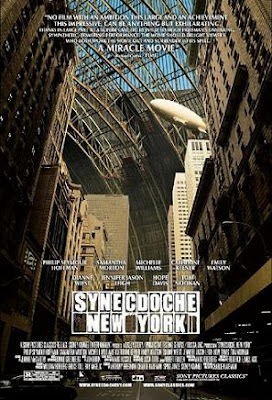
The play's the thing...Charlie Kaufman has done it again. He wrote (and directed) a movie all about what it's like to live inside my head. The first time he did it was with the movie Adaptation, which tells the story of a screenwriter named "Charlie Kaufman" who is trying to adapt a book about orchids into a Hollywood movie. When I saw Adaptation, I felt like Charlie had been listening to my private thoughts and transcribing them onto the page. It was eerie how much the struggles of the character "Charlie Kaufman" mirrored my own. I wondered if anyone else would appreciate a movie that seemed to be directed at me personally.
I've written myself into my screenplay.
Now, Charlie (the actual person) has come out with another movie reflecting the inner workings of my not-so-spotless mind. It is called Synecdoche, New York and it is about a playwright and director named Caden, played by the brilliant Phillip Seymour Hoffman, who creates a play about his own life. But not just any play. The play that Caden creates is an actual, full-scale, real-time depiction of the everyday events of his own life. The play is staged in a massive warehouse which replicates in minute detail the streets, buildings, shops, houses and apartments of Caden's world. Naturally, this replica includes a replica of the warehouse which in turn also replicates Caden's world. And that replica contains another warehouse. And so on.
We're actors. We're the opposite of people.
Of course, the replicas are populated with actors who play the parts of the people in Caden's life, including his wife and daughter and himself. As the play goes on for years and years, these relationships change and grow, both outside and inside the play. Eventually it becomes quite confusing as to who is playing whom. The line between reality and theater becomes blurred to the point of non-existence. Eventually, Caden enters into the world of the play, taking up the part of a minor character. Though, as he puts it: "None of those people is an extra. They're all the leads of their own stories."
Something is rotten in the state of Denmark.
In the play Hamlet, the main character, Hamlet, decides to put on a play to ferret out the murderer of his father. Hamlet tells the actors that the purpose of the play is "to hold as 'twere the mirror up to nature." For a long time, this was the Holy Grail of not just theater, but art in general. Painting, sculpture, literature, photography, theater, cinema, etc., have all sought to reproduce as faithfully as possible the realities of our world and in so doing reveal life's truth. But reality isn't always the truth.
Truth is for suckers, Johnny Boy.
Plenty of artists have taken a very different route from the 'mirror up to nature' one. Picasso wasn't exactly going for photorealism in Guernica. Waiting for Godot doesn't even attempt to portray the world as we know it. Slaughterhouse Five bounces around from one time period to another and even transports two of its characters to a distant planet. But each of these works manages to convey some essential truths.
Let us not waste our time in idle discourse!
Perhaps the 'mirror' is the key. I have a mirror in my bathroom that is normal on one side and magnified on the other. When you hold the magnified mirror up to nature, are you seeing more of the truth or less of it? And what about those mirrors in your car that say 'objects may be closer than they appear'? Sometimes the mirror is lying.
Half of what he said meant something else, and the other half didn't mean anything at all.
In one of my favorite plays, Rosencrantz and Guildenstern Are Dead, two minor characters from Hamlet become the leads in a kind of mirror image version of the original play. Instead of focusing on Hamlet and all his tribulations, this play focuses on the two college buddies who have been invited to Elsinore to cheer Hamlet up after his father's death. Although, once they arrive, they realize they have really been called in to spy on Hamlet to find out why he's acting so crazy. Right from the start, Rosencrantz and Guildenstern begin to notice that the world has stopped making sense. The laws of physics and probability have gone out the window. Logic and reason fail them. They don't know where they are, why they are there, or even which one of them is which. The only person who seems to know what's going on is a character known as The Player, who has been brought in by Hamlet to stage the play-within-the-play that will help Hamlet catch his father's killer. The Player alone seems to realize that they are all caught up in something beyond their understanding, headed for a final act which always ends the same way.
Audiences know what they expect, and that is all they are prepared to believe in.
Synecdoche, New York reflects a world where reality becomes theater and theater becomes reality. A playwright mounts a production dramatizing every moment of his life, spanning nearly two decades, consisting of dozens of sets and hundreds of actors and including a play within a play within a play within a play, and on and on, like a never-ending house of mirrors. And in the end, the main character becomes a bit player and the bit player becomes the lead. Because we are all leads in our own stories. Just like Rosencrantz and Guildenstern.
All the world's a stage, and all the men and women merely players...
So, therefore, I am living in Synecdoche, New York. As are we all. We are all mounting productions of our lives and playing our parts on the world stage. And each of these productions is like a mirror that reflects what we think is the truth. Whether we are from Synecdoche or Ilium or Grover's Corner's or Mayberry.